
How Artificial Intelligence Transforms the Security Industry – From Reactive Protection to Predictive Intelligence

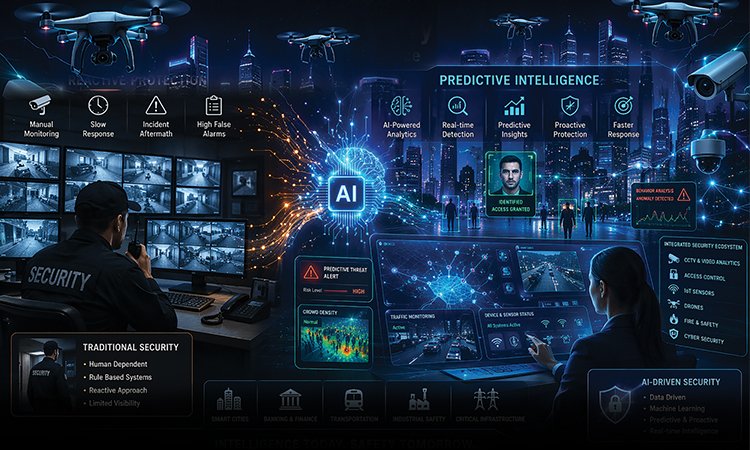
The security industry is undergoing a profound transformation, driven by the rapid advancement of Artificial Intelligence (AI). What was once a domain dominated by manpower-intensive monitoring, static rule-based systems, and reactive responses is now evolving into a dynamic, intelligent, and predictive ecosystem. AI is not merely enhancing existing security frameworks-it is fundamentally redefining how threats are detected, analyzed, and mitigated. Across sectors such as urban infrastructure, manufacturing, banking, transportation, and critical utilities, AI is enabling a shift from traditional security models to proactive, data-driven, and autonomous systems.
The Shift from Reactive to Proactive Security
Historically, security systems operated in a reactive mode—responding to incidents after they occurred. Whether it was CCTV monitoring, access control, or alarm systems, human intervention played a central role in identifying and addressing threats. AI has changed this paradigm. Modern security systems are capable of anticipating risks before they materialize. By analyzing historical data, recognizing patterns, and identifying anomalies, AI enables predictive threat detection. This shift toward proactive security significantly reduces response times and enhances the ability to prevent incidents rather than merely react to them.
AI-Powered Video Surveillance: Beyond Monitoring
One of the most visible applications of AI in the security industry is in video surveillance. Traditional surveillance systems relied on human operators to monitor multiple screens—an approach that was both inefficient and prone to error. AI-driven video analytics has revolutionized this space. Intelligent systems can now automatically detect suspicious activities such as intrusion, loitering, perimeter breaches, and unattended objects. These systems can differentiate between normal and abnormal behavior, drastically reducing false alarms. Facial recognition technology further enhances surveillance capabilities by enabling real-time identification of individuals. This has found applications in airports, railway stations, corporate campuses, and smart cities. While concerns around privacy persist, the operational benefits in terms of speed and accuracy are significant.
Behavioral Analytics and Anomaly Detection
AI has introduced a new dimension to security through behavioral analytics. Instead of focusing solely on visual identification, AI systems analyze patterns of behavior to detect anomalies. For instance, in a crowded environment, AI can identify unusual crowd movements that may lead to potential risks such as stampedes or disturbances. In industrial settings, it can detect unsafe worker behavior, helping prevent accidents. This ability to interpret context and behavior enhances situational awareness and enables timely intervention.
AI in Access Control and Identity Management
Access control systems have also evolved significantly with AI integration. Traditional systems based on keycards or passwords are increasingly being replaced by biometric and AI-driven solutions. Facial recognition, fingerprint scanning, and even gait analysis are being used to authenticate individuals. AI enhances these systems by learning user patterns and detecting anomalies, such as unauthorized access attempts or identity spoofing. In high-security environments, AI-driven access control systems can dynamically adjust permissions based on risk levels, time of day, or user behavior, adding an extra layer of intelligence and flexibility.
Cybersecurity: AI as Both Shield and Sword
As the digital landscape expands, cybersecurity has become a critical component of the security industry. AI is playing a dual role—both as a defense mechanism and as a tool that can be exploited by cybercriminals. On the defensive side, AI-powered systems can monitor network traffic, detect unusual patterns, and identify potential threats such as malware, phishing attacks, and unauthorized access. Machine learning algorithms continuously evolve, enabling systems to adapt to new and emerging threats. AI also supports automated incident response, reducing the time required to contain and mitigate cyberattacks. However, the same technology can be used by attackers to develop more sophisticated threats, making it a constantly evolving battlefield.
Predictive Analytics: Anticipating Threats
Predictive analytics is one of the most transformative aspects of AI in security. By analyzing large volumes of data, AI systems can identify trends and forecast potential risks. In urban environments, predictive policing models can identify crime hotspots, enabling law enforcement agencies to allocate resources more effectively. In industrial settings, predictive analytics can identify vulnerabilities in infrastructure, preventing accidents and operational disruptions. This forward-looking approach not only enhances security but also optimizes resource utilization, making it a powerful tool for both public and private sectors.
Integration with IoT and Smart Infrastructure
The convergence of AI with the Internet of Things (IoT) has created interconnected security ecosystems. Sensors, cameras, alarms, and other devices are now part of a unified network that communicates and collaborates in real time. AI acts as the central intelligence layer, analyzing data from multiple sources and enabling coordinated responses. For example, in a smart building, an AI system can integrate surveillance data with access control and fire detection systems to provide a comprehensive security solution. In smart cities, AI-powered security systems are integrated with traffic management, emergency response, and public safety frameworks, enhancing overall urban resilience.
Automation and Reduced Human Dependency
AI is significantly reducing the dependency on manual intervention in security operations. Tasks such as monitoring, threat detection, and reporting are increasingly being automated. This not only improves efficiency but also allows human resources to focus on more strategic and complex tasks. Automation also ensures consistency and eliminates the fatigue-related errors that are common in human-driven systems. However, this does not imply the complete replacement of human roles. Instead, AI acts as a force multiplier, augmenting human capabilities and enabling better decision-making.
Real-Time Decision Making and Edge AI
The integration of AI with edge computing is enabling real-time decision-making at the source of data generation. Edge AI allows devices such as cameras and sensors to process data locally, reducing latency and dependency on centralized systems. This is particularly important in critical applications such as border security, defense, and industrial safety, where immediate response is crucial. Real-time analytics ensures that threats are identified and addressed without delay.
AI in Fraud Detection and Financial Security
In the financial sector, AI is playing a crucial role in detecting and preventing fraud. By analyzing transaction patterns and user behavior, AI systems can identify anomalies that may indicate fraudulent activity. Banks and financial institutions are leveraging AI to enhance customer security, reduce financial losses, and comply with regulatory requirements. Real-time fraud detection systems have become an essential component of modern financial security frameworks.
Ethical, Privacy, and Regulatory Challenges
Despite its numerous advantages, the adoption of AI in the security industry raises important ethical and regulatory concerns. Issues related to privacy, data protection, and surveillance overreach are becoming increasingly prominent. Facial recognition and behavioral analytics, in particular, have sparked debates around individual rights and consent. Ensuring transparency, accountability, and compliance with data protection regulations is critical to building trust in AI-driven security systems. Organizations must adopt responsible AI practices, balancing technological advancement with ethical considerations.
AI and the Future of Security Workforce
The integration of AI is reshaping the security workforce. While automation may reduce the need for certain roles, it is also creating new opportunities in areas such as data analysis, system management, and cybersecurity. Upskilling and reskilling of the workforce will be essential to adapt to this changing landscape. Security professionals will need to develop a deeper understanding of AI technologies and their applications.
Toward Autonomous Security Systems
The future of the security industry lies in fully autonomous systems powered by AI. These systems will be capable of detecting, analyzing, and responding to threats with minimal human intervention. Emerging technologies such as deep learning, advanced biometrics, and AI-driven robotics will further enhance security capabilities. The integration of AI with 5G and next-generation communication technologies will enable faster and more efficient data processing. In the Indian context, the adoption of AI in security is expected to accelerate, driven by smart city initiatives, industrial automation, and increasing awareness of security challenges.
Intelligence as the New Security Paradigm
Artificial Intelligence is not just an enabler—it is the driving force behind the transformation of the security industry. By turning data into actionable intelligence, AI is redefining how security is perceived and implemented. From predictive threat detection to real-time response and integrated ecosystems, AI is ushering in a new era of intelligent security. As challenges around privacy and ethics are addressed, the potential of AI to create safer, smarter, and more resilient environments will continue to expand. For organizations and governments alike, embracing AI-driven security is no longer optional—it is a strategic imperative in an increasingly complex and interconnected world.