
Systems Failure Modes in Industrial Safety : Three Layer Cascade in Manufacturing


Senior Technical Program Manager, Applied Materials | ex-Tesla.
Industrial safety failures are rarely caused by extraordinary events; they result from routine work carried out in environments where known risks remain unresolved. Despite strict regulations and significant investments, high-risk industries continue to experience preventable incidents that lead to substantial human and economic losses, states Krunal Patel, emphasizing the need for proactive prevention rather than reactive response.
Industrial safety failures do not require extraordinary circumstances. They only require everyday work to proceed inside an organization that has left key risks uncorrected.Work related death and disease remain among the largest preventable burdens on the global economy [1], and the weight falls hardest where industrial growth outruns occupational health infrastructure and enforcement [2]. Risk sits in a familiar group of sectors, among them manufacturing, mining, oil and gas, construction, utilities and chemicals, which are also the most heavily regulated and the best funded for safety. That is what makes the outcome so difficult to accept. Most of cost simply arrives after the event, in compensation, replacement, downtime, and legal exposure, because those costs come with an invoice and prevention does not [3]. Across the hardware industries and manufacturing, where I have spent my career moving products from bench through factory floor to market, incident reviews end the same way. Three failures stand behind one safety cause, and they might most likely occur in a fixed order.
Layer one: Strategic blind spots
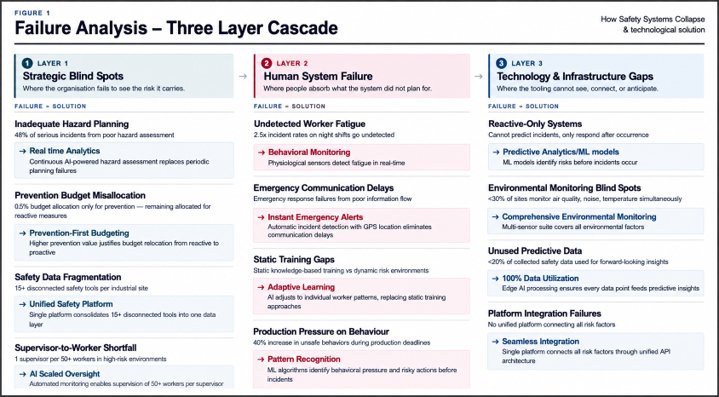
This is where an organization fails to see the risk it carries. Hazard planning is the first weak point, performed on a calendar, written for a generic version of the task, and rarely reopened; the work changes and the document does not. Budget misallocation is the second, since prevention is usually the smallest line in a safety budget. Data fragmentation is the third, because a site runs tools bought separately and never made to exchange information, so no one sees a single picture of risk. Supervision is the fourth, since one supervisor covering a large crew turns attention into a rationed resource.Organizations gather incident information and still fail to convert it into changed practice [4], [5], [6]. This layer fails quietly, by omission, and passes the unresolved risk downstream.
Layer two: Human system failure
This is where people absorb what the system did not plan for. Fatigue goes undetected, because those most impaired are least able to judge their own impairment and night work removes the supervision daylight provides. Emergency communication is the second, since the delay between an event and a response depends on someone noticing and someone being reachable. Training is the third, delivering fixed knowledge on a fixed schedule to conditions that change hourly [7]. Production pressure is the fourth, because the organization has made speed the visible measure and safety the invisible one.
Workers routinely absorb the distance between how work is imagined and how it must be performed [8]. That absorption is treated as competence until the day it is treated as negligence.
Layer three: Technology and infrastructure gaps
This is where the tooling cannot see, connect, or anticipate. Monitoring is reactive by design, registering a condition once it has crossed a threshold, which makes it a record keeper, not a warning. Environmental coverage is thin, because gas, heat, noise, motion, and location are measured by different instruments, in different places, almost never at the worker. Collected data closes a report rather than anticipating the next incident [9], and platforms do not integrate, so one risk factor is never read against another. Near miss reporting improves performance only when reports feed a structured learning loop [10], [11]. Most sites have reports. Few have the loop.The capability gap is not technical. Predictive models identify defects before failure [12], [13] and root cause analysis supports resilient decision making [14], yet deployment remains uneven outside large enterprises [15].
Set side by side, the layers form one map, and each failure has a technology response capable of closing it.
Why the order matters
Each layer hands its unresolved risk to the layer below, so the worker stands last with the least protection. Correction has to travel the other way. Put continuous sensing where the worker stands, act on it locally in seconds, and feed that evidence back into hazard planning and the budget. Safety spending is not too small, it is aimed at the wrong end of the sequence.
References
- International Labour Organization, Safety and Health at the Heart of the Future of Work: Building on 100 Years of Experience. Geneva: International Labour Office, 2019.
- Pingle, “Occupational safety and health in India: Now and the future,” Industrial Health, vol. 50, no. 3, 2012.
- Bakshi and H. Peura, “Prevent or report? Managing near misses for safer operations,” Manufacturing and Service Operations Management, vol. 24, no. 4, 2022.
- Stemn, C. Bofinger, D. Cliff, and M. E. Hassall, “Failure to learn from safety incidents: Status, challenges and opportunities,” Safety Science, vol. 101, 2018.
- B. Dahlin, Y. T. Chuang, and T. J. Roulet, “Opportunity, motivation, and ability to learn from failures and errors: Review, synthesis, and ways to move forward,” Academy of Management Annals, vol. 12, no. 1, 2018.
- H. Rezazade Mehrizi, D. Nicolini, and J. R. Mòdol, “How do organizations learn from information system incidents? A synthesis of the past, present, and future,” MIS Quarterly, vol. 46, no. 1, 2022.
- Clare and K. I. Kourousis, “Learning from incidents in aircraft maintenance and continuing airworthiness: Regulation, practice and gaps,” Aircraft Engineering and Aerospace Technology, vol. 93, no. 2, 2021.
- J. Provan, D. D. Woods, S. W. A. Dekker, and A. J. Rae, “Safety II professionals: How resilience engineering can transform safety practice,” Reliability Engineering and System Safety, vol. 195, 2020.
- Thoroman, N. Goode, and P. Salmon, “System thinking applied to near misses: A review of industry wide near miss reporting systems,” Theoretical Issues in Ergonomics Science, vol. 19, no. 6, 2018.
- G. Gnoni, F. Tornese, A. Guglielmi, M. Pellicci, G. Campo, and D. De Merich, “Near miss management systems in the industrial sector: A literature review,” Safety Science, vol. 150, 2022.
- J. Haas, B. Demich, and J. McGuire, “Learning from workers’ near miss reports to improve organizational management,” Mining, Metallurgy and Exploration, vol. 37, no. 3, 2020.
- Tercan and T. Meisen, “Machine learning and deep learning based predictive quality in manufacturing: A systematic review,” Journal of Intelligent Manufacturing, vol. 33, no. 7, 2022.
- Papageorgiou, T. Theodosiou, A. Rapti, E. I. Papageorgiou, N. Dimitriou, D. Tzovaras, and G. Margetis, “A systematic review on machine learning methods for root cause analysis towards zero defect manufacturing,” Frontiers in Manufacturing Technology, vol. 2, 2022.
- Ito, M. Hagström, J. Bokrantz, A. Skoogh, M. Nawcki, K. Gandhi, D. Bergsjö, and M. Bärring, “Improved root cause analysis supporting resilient production systems,” Journal of Manufacturing Systems, vol. 64, 2022.
- Z Chavez, J. B. Hauge, and M. Bellgran, “Industry 4.0, transition or addition in SMEs? A systematic literature review on digitalization for deviation management,” The International Journal of Advanced Manufacturing Technology, vol. 119, no. 1, 2022.
[Reproduced from ISR, Jan 24]
Article by Krunal Patel