
The Vertical Risk: Understanding Elevator System Behaviour in India’s High-Rise Buildings

By Madhava Narasimha Murthy Nedunuri
Abstract
India’s urban landscape is increasingly defined by vertical development. Residential towers exceeding forty floors, large commercial office complexes, and multi-speciality hospitals are now common features of metropolitan growth. Elevators in these environments are no longer simple transport devices. They function as critical vertical mobility infrastructure whose reliability directly influences building safety, emergency response, and operational continuity. Within these structures, elevators have evolved from simple convenience devices into essential mobility infrastructure that determines how people move, how buildings operate, and how emergency situations are managed.
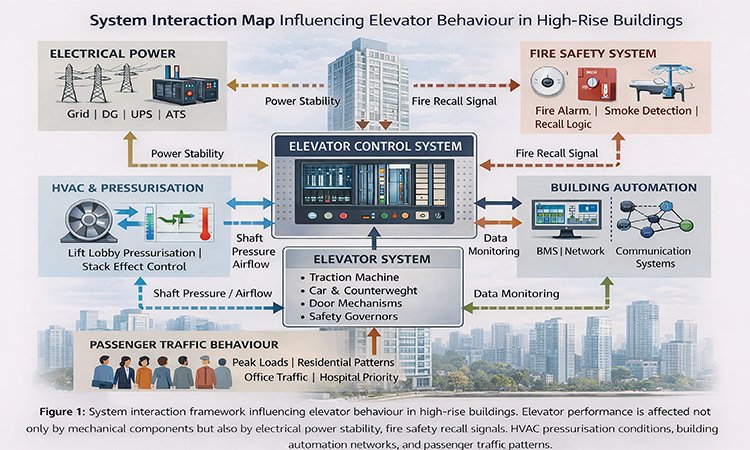
Despite their critical role, elevator safety discussions in the industry often remain focused on equipment compliance, certification requirements, and periodic inspection regimes. While these measures remain important, they address only part of the safety challenge. Elevators operate within a complex ecosystem that includes electrical power infrastructure, fire safety systems, HVAC pressurisation strategies, building automation platforms, and dynamic passenger behaviour.
In many real operating scenarios, elevator safety risks emerge not because components fail, but because system interactions create unexpected conditions. Power disturbances during generator transitions, smoke movement within lift shafts during fire incidents, peak passenger loads in residential towers, and network interruptions in destination control systems can all influence elevator behaviour.
This article examines elevator safety through a system behaviour lens. By analysing elevator performance across residential towers, commercial buildings with destination control systems, and hospital environments, the article highlights how building typology influences vertical transportation risks. It also explores how electrical infrastructure, environmental conditions, and lifecycle maintenance practices interact with elevator systems. Understanding elevators as integrated building systems rather than isolated mechanical equipment is essential for improving safety in India’s rapidly growing high-rise environments.
Elevators in the Era of Vertical Urbanisation
India’s construction sector is undergoing a structural shift toward vertical growth. Rapid urbanisation and land scarcity in major cities have pushed development upward, resulting in residential towers housing thousands of occupants within a single structure. Commercial developments now accommodate entire corporate ecosystems across multiple floors, while hospitals operate as vertically integrated healthcare environments.
Within these buildings, elevators perform a function similar to transportation networks within cities. They regulate the movement of people and services across different levels of activity. When elevator systems function reliably, building circulation remains efficient and predictable. When elevators behave unpredictably or experience operational disturbances, the entire building ecosystem can be affected.
Traditionally, elevator safety was associated primarily with mechanical reliability. Engineers focused on ensuring the proper functioning of braking systems, overspeed governors, traction machines, and door interlocks. These components remain critical, but the context in which elevators operate has changed significantly.
Modern buildings integrate multiple building services that interact continuously. Elevator performance is influenced by electrical power quality, generator synchronisation behaviour, fire detection and smoke management systems, HVAC pressurisation strategies, and building automation platforms. Passenger traffic density has also increased as buildings accommodate larger populations.
As a result, elevator safety is gradually shifting from a component reliability problem to a system interaction challenge. An elevator system may be mechanically sound, yet operational disruptions may still occur because of external factors such as unstable power supply, control network interruptions, or environmental conditions within lift shafts.
Understanding elevator safety therefore requires engineers to examine how elevators behave within the broader building infrastructure.
System Interactions That Influence Elevator Behaviour
Elevators rarely operate independently. Their performance depends on several interconnected building systems that influence operational stability.
Key interactions include:
• Electrical supply stability and generator transition performance
• Fire detection systems triggering elevator recall sequences
• HVAC pressurisation affecting shaft air pressure
• Building automation platforms controlling operational modes
• Communication networks linking group controllers and dispatch algorithms
• Passenger traffic behaviour influencing system load
Under normal conditions these systems function together without difficulty. However, during disturbances such as grid power failure or fire alarm activation, the interaction between these systems becomes far more complex.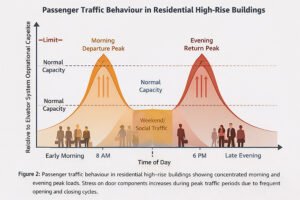
For example, when grid power fails, diesel generators must start and stabilise before elevators can resume operation. If voltage stabilisation takes longer than expected, elevator control systems may reset temporarily. Similarly, fire alarm activation can trigger recall sequences that remove elevators from passenger service and send them to designate floors.
In high-rise buildings, this transition phase between grid power loss and generator stabilisation represents a particularly sensitive operating window for elevator systems. Voltage fluctuations, frequency instability, or delayed synchronisation can cause elevator controllers to initiate protective shutdown sequences. As a result, the design of electrical infrastructure including UPS support for control circuits and Automatic Rescue Devices (ARD) plays a critical role in ensuring that elevator cars move safely to the nearest landing during power disturbances These examples demonstrate that elevator behaviour during critical events is influenced not only by mechanical components but also by the coordination of multiple building systems.
Residential High-Rise Buildings: Behaviour Under Peak Traffic
Residential towers present a unique operational environment because passenger traffic tends to occur in concentrated periods rather than being evenly distributed throughout the day.
Typical daily patterns include strong morning departure peaks when residents leave for work or school, followed by evening return peaks when occupants arrive home. These concentrated movements place significant demand on elevator systems.
During peak periods, passenger behaviour often amplifies operational stress. Occupants frequently attempt to maximise elevator capacity, sometimes obstructing doors to allow additional passengers to enter. Repeated obstruction increases wear on door motors, rollers, and sensors.
Door assemblies represent one of the most frequently serviced components in residential elevator systems. Continuous peak-hour stress accelerates component fatigue and increases long-term maintenance requirements.
In very tall residential towers, traffic intensity increases further because lift groups often serve multiple zones. Buildings exceeding forty or fifty floors typically divide elevators into low-rise and high-rise banks. While this improves average travel time, it can introduce transfer behaviour at intermediate levels, especially in developments incorporating sky lobbies or mixed-use podiums. When occupants move between zones or when service elevators are temporarily used for passenger movement during peak hours, the dispatch system may experience additional load conditions that were not fully anticipated during design calculations.
Another behavioural factor affecting elevator operation in residential towers is the presence of service movement during peak passenger hours. Housekeeping staff, delivery personnel, and maintenance teams often share the same vertical infrastructure used by residents. Without clear operational segregation between passenger and service elevators, traffic conditions may become unpredictable. This can increase waiting times, encourage passengers to overload elevator cars, and place additional stress on door systems and dispatch algorithms.
Careful zoning of passenger lifts, dedicated service elevators, and thoughtful traffic planning therefore play important roles in maintaining stable elevator performance in high-density residential developments.
Commercial Buildings and Destination Control Systems
Commercial office buildings operate under very different traffic dynamics. Instead of concentrated peaks, these buildings experience continuous passenger movement throughout the working day. To manage this demand efficiently, many modern commercial towers use Destination Control Systems (DCS). In DCS systems, passengers enter their destination floor before boarding. The control system groups passengers travelling to similar floors and assigns them to specific elevators. This approach significantly improves efficiency in buildings with large occupant populations. However, the centralised nature of destination control introduces new operational dependencies. Unlike traditional elevator dispatch systems, DCS relies heavily on communication networks and central controllers that coordinate elevator groups. Any disruption to these networks can influence elevator behaviour. Incorrect passenger input or misuse of the interface may also affect dispatch optimisation.
Emergency events introduce additional complexity. During fire alarms or system disturbances, elevators must transition from traffic optimisation mode to emergency recall mode. Effective coordination between elevator controls, fire detection systems, and building automation platforms is therefore essential.
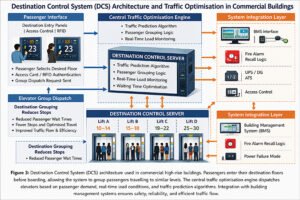
Another important consideration in commercial buildings is the interaction between elevator traffic management and the overall building evacuation strategy. During fire or other emergency scenarios, elevators must transition immediately from optimisation mode to controlled recall operation. In buildings equipped with DCS, this transition involves the coordinated shutdown of destination panels, the reassignment of elevator cars to designated recall floors, and the prevention of new passenger dispatch commands. If communication between the elevator control network and the fire alarm system is delayed or improperly configured, the system may continue to process passenger requests during the early stages of an emergency event.
In addition, large commercial buildings often integrate elevators with building management systems (BMS) for monitoring operational performance. Real-time data related to car position, door cycles, waiting times, and fault conditions can provide valuable insights into system behaviour. When analysed systematically, this information allows facility managers to identify emerging performance bottlenecks, optimise traffic handling strategies, and detect abnormal operating patterns before they evolve into reliability issues.
Hospitals: Elevators as Critical Operational Infrastructure
Hospitals represent one of the most demanding environments for elevator systems because vertical transportation directly supports clinical operations. In healthcare facilities, elevators transport patients on stretchers, enable rapid movement of doctors and nurses between departments, and allow the movement of medical equipment and supplies. Reliability therefore becomes directly connected to patient care. Hospital elevators must accommodate specialised operational requirements including stretcher movement, priority service for emergency transport, and coordination with medical workflows. These elevators typically require larger car dimensions and smoother acceleration profiles to ensure safe patient transport. Electrical reliability is also critical. Hospitals depend on emergency power infrastructure to maintain uninterrupted operations. Elevator systems must remain operational during power disturbances so that patient transfers and emergency response activities are not compromised.
Hospital elevator systems must also accommodate strict hygiene and infection control requirements. In many healthcare facilities, elevators used for patient transport must be segregated from service lifts that handle waste, linen, and medical supplies. Without proper operational separation, vertical circulation pathways may inadvertently mix sterile and non-sterile movement streams. Careful planning of lift zoning and operational protocols therefore becomes an important aspect of hospital design.
Another operational challenge arises during emergency medical situations when multiple departments simultaneously require elevator access. Emergency departments, operating theatres, and intensive care units may all depend on rapid vertical transport during critical procedures. Elevator control logic must therefore prioritise medical transport requests while maintaining predictable response times for other hospital activities. Designing elevator systems that balance priority access with operational continuity requires close coordination between hospital planners, elevator engineers, and facility management teams.
Environmental Behaviour of Elevator Shafts
Elevator shafts are often considered structural spaces within buildings, but they also behave as vertical environmental zones. Temperature differences between indoor and outdoor environments create pressure gradients inside lift shafts, a phenomenon known as the stack effect. In tall buildings, these pressure differences may influence airflow between floors. Stack effect can affect elevator operation by altering door opening forces, airflow patterns within lift lobbies, and pressure conditions inside shafts.
Wind forces acting on tall buildings can also influence shaft pressure behaviour. Positive pressure may develop on windward facades while negative pressure occurs on leeward sides. These variations can drive airflow through lift lobby openings and influence elevator door performance. Elevator shafts can also act as vertical pathways for sound transmission. Mechanical vibrations from traction machines or guide rails may propagate through the shaft structure and become audible in adjacent residential or office spaces. Modern high-rise design therefore often incorporates vibration isolation strategies and acoustic control measures to minimise noise transmission.
Environmental conditions within lift pits must also be carefully managed. Water ingress due to groundwater infiltration or drainage failures can accumulate in pits and damage electrical components. Proper drainage systems and water detection sensors help mitigate these risks.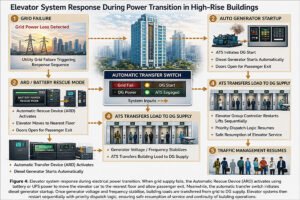
Maintenance and Lifecycle Reliability
Elevator safety evolves throughout the lifecycle of a building. Even well-designed systems require consistent maintenance and periodic reassessment to maintain safe operation. Mechanical components such as door mechanisms, traction ropes, braking systems, and guide rollers operate under continuous mechanical cycles. Over time, wear and environmental exposure gradually influence system behaviour.
Modern elevator systems increasingly incorporate monitoring technologies capable of detecting abnormal vibration levels, temperature variations, and mechanical wear. By analysing operational data from these sensors, maintenance teams can identify early warning signs of system degradation and schedule corrective interventions before failures occur.
Conclusion: Engineering Safer Vertical Mobility in India’s High-Rise Buildings
India’s rapidly growing vertical cities depend heavily on elevator systems to sustain daily mobility and operational continuity within buildings. Elevators influence how residents access their homes, how employees move within workplaces, and how patients are transported within healthcare facilities. The safety of these systems can no longer be evaluated solely through compliance with equipment standards.
As buildings become taller and more technologically integrated, elevator behaviour is increasingly influenced by interactions with electrical infrastructure, fire safety systems, environmental conditions, and human usage patterns. Improving elevator safety therefore requires a broader engineering perspective that recognises elevators as part of an interconnected building ecosystem. Electrical power reliability, shaft environmental control, fire safety coordination, and predictive maintenance strategies must all be integrated into the design and operation of vertical transportation systems.
Equally important is the need to evaluate elevator performance throughout the lifecycle of a building. As occupancy patterns evolve and equipment ages, continuous monitoring and periodic system reassessment become essential to maintain safety margins. Future elevator safety strategies should therefore include integrated system testing, coordinated emergency response simulations, and continuous monitoring of elevator performance within the broader building infrastructure. Through thoughtful engineering design, integrated building infrastructure, and proactive lifecycle management, elevators can continue to function as reliable lifelines within India’s increasingly vertical built environment.