
The Air Knows First : Rethinking Fire Detection Before Smoke Becomes Visible
By Madhava Narasimha Murthy Nedunuri

Abstract
Modern buildings are becoming increasingly dense with electrical infrastructure, power electronics, battery systems, automation platforms, and mission-critical equipment. As these environments grow more complex, the nature of fire risk is also evolving. Traditional fire detection strategies have historically focused on identifying visible smoke, elevated temperature, or flame before initiating alarms and emergency response. While these methods remain fundamental to life safety design, they increasingly face limitations in environments where even small detection delays can significantly affect intervention outcomes.
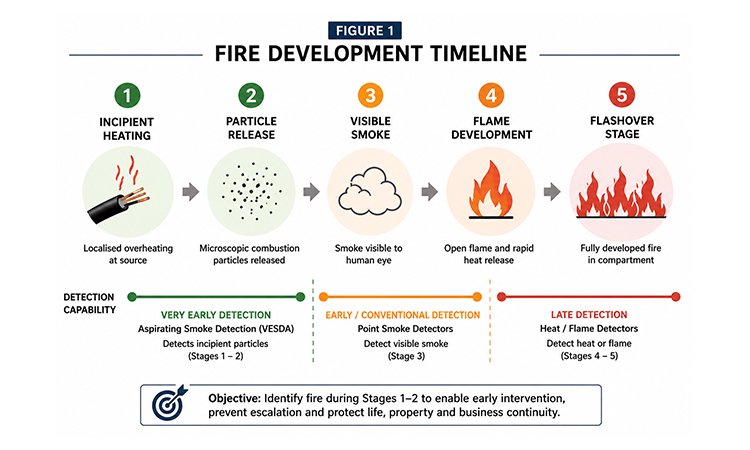
In many critical spaces, fire does not begin with visible smoke or flame. It often begins with abnormal thermal behaviour such as cable insulation degradation, overheating electrical terminations, PCB failure, battery instability, or localized equipment hotspots. During these early stages, microscopic combustion aerosols and ultrafine particulate matter may already be present in the environment despite the absence of visible fire signatures. These invisible changes in air composition often represent the earliest evidence of an incipient fire event.
This article examines fire detection through a broader engineering lens, moving beyond conventional alarm philosophy toward early warning intelligence. It explores the science of incipient fire development, the practical limitations of conventional detection systems, the growing importance of aspirating detection technologies such as VESDA, and the critical role of coordinated system response. It also introduces the B.R.E.A.T.H. Framework, a practical methodology for evaluating fire detection performance from first-particle recognition to effective emergency intervention.
The future of fire detection may depend less on identifying visible smoke and more on recognizing the earliest invisible signatures of combustion. In many modern buildings, by the time occupants see smoke, valuable response time may already have been lost.
Fire Starts Quietly
Fire engineering is often influenced by visual imagination. When people think about fire, they typically imagine flames, smoke-filled spaces, alarm sounders, evacuation, and visible chaos. In reality, most fires begin far more quietly.
A termination inside an LT panel may develop increasing contact resistance due to inadequate tightening torque. A UPS battery cell may enter thermal instability after repeated charge-discharge stress. Cable insulation inside a densely packed riser may begin degrading under sustained heat. A server power supply board may experience localized component failure. In each of these cases, the earliest stages of fire development may remain completely invisible to occupants and operations teams. There may be no visible smoke. No flames. No immediate alarm.
Yet the fire event may already have begun. This is one of the most overlooked realities in practical fire engineering. Fire is rarely an instantaneous phenomenon. In many cases, it is a progressive thermal event that evolves through multiple stages before becoming visually obvious. Long before visible smoke appears, abnormal heating may initiate material decomposition, insulation carbonization, pyrolysis, and release of microscopic combustion aerosols into the surrounding environment.
These early signatures are rarely perceived by humans. They are, however, physically present. This creates an important engineering concern. In critical environments, the difference between detecting fire during incipient particle release and detecting it after visible smoke formation can determine whether the event remains manageable or escalates into major asset damage, operational disruption, or life safety compromise. As buildings become more electrically dense and operationally complex, the engineering question must evolve. The question is no longer limited to whether fire can be detected. The more important question is whether the earliest signature of fire can be identified before escalation begins.
The Problem with Waiting for Smoke
Conventional fire detection systems remain the backbone of modern fire safety design. Smoke detectors, heat detectors, beam detectors, flame detectors, and linear heat sensing systems have protected buildings for decades and continue to serve essential functions in life safety engineering. The limitation of these systems is not that they fail.
The limitation is that they may succeed exactly as designed and still be too late. Most conventional detection systems are passive by nature. Smoke detectors wait for combustion products to reach their sensing chamber in measurable concentration. Heat detectors wait for thermal thresholds or rate-of-rise conditions. Flame detectors wait for optical recognition of combustion.
This dependency introduces delay. The delay is not always caused by detector performance but by fire dynamics and environmental behaviour. Smoke movement depends heavily on airflow paths, pressure differentials, temperature gradients, ceiling geometry, and HVAC behaviour. In large-volume spaces, dilution can delay alarm thresholds. In high-ceiling environments, stratification can delay detector activation. In heavily air-conditioned spaces, return-air capture may redirect combustion particles away from detector zones.
This becomes especially relevant in engineered environments with complex airflow patterns. A switchgear compartment experiencing localized overheating may generate combustion products within an enclosed volume while the surrounding room still appears normal. A data center with aggressive cooling airflow behaves differently from a conventional office. A battery room with forced ventilation behaves differently from a utility substation.
This creates the hidden delay in conventional detection. The practical concern is therefore not whether detectors work. The real concern is whether detection occurs early enough to create meaningful intervention opportunity. In practice, many projects still treat fire detection as a code-compliance deliverable rather than a performance-engineered safety system. Detector spacing, zoning, and panel integration often receive greater attention than incipient detection capability or response intelligence. Compliance may satisfy statutory approval, but compliance alone does not guarantee early warning performance.
The Air Knows First
Before smoke becomes visible, the environment often changes in ways that conventional fire detection philosophy does not fully capture. The earliest evidence of fire is frequently not visual. It is airborne.During incipient fire stages, materials subjected to abnormal thermal stress begin releasing microscopic combustion aerosols, ultrafine particles, and gaseous decomposition products. These emissions may remain far below human visibility thresholds, yet they represent the earliest measurable indicators of abnormal thermal behaviour.
This changes the way fire detection must be viewed. Traditional detection systems are event-driven. They respond once combustion signatures become sufficiently pronounced to trigger alarm thresholds. Early warning detection, by contrast, focuses on identifying subtle deviations in environmental behaviour before conventional alarm conditions develop.
Air becomes central to this approach. Combustion particles do not remain confined to the source of failure. They travel along airflow paths defined by HVAC supply and return systems, containment arrangements, pressure relationships, cooling strategies, cable trenches, and room geometry. In many environments, air movement distributes these microscopic particles well before visible smoke formation.
From an engineering standpoint, this leads to an important conclusion. The earliest detectable evidence of fire may not be smoke. It may be a measurable deviation in air quality caused by microscopic combustion signatures. This is why the future of fire detection increasingly depends on understanding not only combustion behaviour, but also airflow behaviour. A code-compliant fire alarm system should not automatically be assumed to be an early warning system.
VESDA: From Detection to Anticipation
The growing limitations of conventional detection in critical environments have driven the evolution of a different detection philosophy, one focused not merely on smoke detection but on recognition of the earliest measurable deviation from normal environmental behaviour. This is where aspirating smoke detection systems such as VESDA (Very Early Smoke Detection Apparatus) become highly relevant. The fundamental difference between conventional smoke detection and VESDA lies in the sensing philosophy. Conventional detectors are passive. They wait for combustion products to reach the sensing element. VESDA actively draws air from the protected environment through a distributed pipe network into a highly sensitive laser-based sensing chamber. This transforms detection from passive waiting into active environmental sampling. VESDA should not be understood merely as a more sensitive smoke detector. Its real value lies in enabling earlier recognition of abnormal thermal behaviour. Instead of asking whether smoke has become sufficiently visible for alarm activation, the system continuously evaluates whether particulate behaviour has deviated from its normal baseline.
The sensitivity difference is significant. Conventional point smoke detectors typically operate at obscuration thresholds around 1–3% per meter, depending on detector type and alarm philosophy. Very early warning aspirating systems can detect particulate concentrations at much lower obscuration levels, often in the range of 0.001–0.005% per meter in high-sensitivity applications. While exact values vary with detector class and configuration, the engineering implication is clear: meaningful detection can occur orders of magnitude earlier than visible smoke thresholds. This creates intervention opportunity during the incipient phase.
A failing UPS connection, an overheating busbar joint, a deteriorating PCB component, or a lithium-ion battery entering early instability may initially release only microscopic combustion aerosols. At this stage, visible smoke may still be absent, and conventional detection may remain inactive. However, these minute airborne signatures may already be measurable through aspirating detection. However, higher sensitivity introduces a new engineering challenge. Sensitivity without intelligence creates noise.
Systems designed to detect microscopic particulate changes must distinguish genuine combustion signatures from nuisance conditions such as dust ingress, contamination events, maintenance activities, or transient air-quality disturbances. The real value therefore lies not only in sensitivity, but in intelligent threshold management, trend analysis, and staged alarm logic.This marks the transition from fire detection toward fire anticipation.
Where Early Detection Changes Outcomes
Very early warning detection is not necessary for every occupancy. Fire engineering should remain risk-driven rather than technology-driven. The question is not whether every building requires advanced aspirating detection. The more relevant question is where delayed detection creates unacceptable consequences.
Consider a 5 MW data center supporting AI workloads. A localized PSU failure inside a high-density server rack begins releasing microscopic combustion aerosols due to PCB overheating. Cooling airflow rapidly transports these particles through the cold aisle while no visible smoke is yet detectable. Conventional detectors remain inactive. By the time visible smoke forms, multiple adjacent racks may already be exposed, converting a localized component fault into a wider operational event.
Now consider an 11 kV switchgear room in a high-rise development. A cable termination develops high contact resistance due to improper torque tightening during installation. Over time, localized heating accelerates insulation degradation and carbonization. The earliest evidence is not flame or visible smoke but microscopic particulate release inside the enclosure. If detection begins only after visible smoke escapes the panel, valuable intervention time may already have been lost.
A third example comes from battery energy storage systems. Lithium-ion thermal runaway rarely begins with visible fire. It often starts with cell instability, internal decomposition, off-gassing, and localized temperature escalation. By the time visible smoke appears, the event may already be transitioning from a detection challenge into a suppression challenge. These scenarios differ in application but share one common engineering truth. The higher the consequence of delayed intervention, the greater the value of early detection intelligence.
Detection, Interpretation and Response
One of the most common misconceptions in fire engineering is the assumption that successful detection automatically translates into effective protection. In practice, detection is only the beginning of the protection chain. A fire detection system may successfully identify abnormal particulate behaviour, generate alarms precisely as designed, and still fail to prevent escalation if subsequent interpretation and response are inadequate. The presence of an alarm signal does not automatically create meaningful intervention.
Between detection and protection lies a critical sequence of system and human responses. Alarm signals must be interpreted correctly. Threat severity must be assessed appropriately. Cause-and-effect logic must function as intended. Connected building systems must respond in coordinated fashion. Operations teams must understand required actions and execute them without delay.
Weakness in any part of this chain can undermine the benefit of early detection. This is particularly relevant in facilities where repeated nuisance alarms create alarm fatigue. When operators frequently encounter false or non-critical alerts, abnormal signals may gradually be normalized and treated as maintenance noise, dust contamination, or transient disturbances instead of genuine warning indicators.
This is why early warning detection must be evaluated as part of an integrated building response ecosystem rather than as an isolated detector performance metric. Modern fire detection systems increasingly interact with multiple engineering systems, including fire alarm panels, HVAC controls, smoke management systems, lift recall logic, building management systems, public address infrastructure, and security command centers. From an engineering perspective, the true performance metric of fire detection is therefore not alarm activation speed alone. It is the quality of intervention enabled by that detection. Detection without effective interpretation remains information. Detection combined with coordinated response becomes protection.
The B.R.E.A.T.H. Framework for Early Fire Detection Intelligence
The discussion so far highlights a central engineering reality. Early detection alone does not guarantee resilience. Detection systems must be evaluated not only by sensing capability but by their ability to convert early warning into meaningful intervention. To assess this more effectively, fire engineers need a broader framework extending beyond detector selection and code compliance. The B.R.E.A.T.H. Framework provides a practical methodology for evaluating early fire detection intelligence across the complete protection chain.
B – Baseline Air Behaviour
Early warning detection begins with understanding what normal looks like. Every protected environment has a particulate signature shaped by occupancy, ventilation patterns, contamination levels, equipment loading, and operational activity. Without a reliable baseline, abnormal combustion signatures can easily be mistaken for environmental noise.
R – Recognise Abnormal Particles
Incipient fire events often begin with microscopic combustion aerosols generated during thermal degradation. Recognizing these abnormal particles creates the earliest opportunity for intervention before visible smoke or flame develops.
E – Evaluate Threat Intelligence
Not every particulate increase indicates fire. Dust ingress, maintenance activities, and environmental disturbances may generate nuisance signals. Effective systems must distinguish genuine threat signatures from background variability.
A – Activate Detection Logic
Response thresholds should be intelligent and progressive rather than binary. Multi-stage alarm logic enables investigation, escalation, and emergency activation according to evolving threat severity.
T – Trigger Coordinated Response
Detection becomes valuable only when it initiates integrated action across fire alarm systems, HVAC controls, smoke management systems, BMS platforms, lifts, communication systems, and emergency teams.
H – Hold Safe Conditions
The ultimate objective of fire detection is not alarm generation. It is maintaining survivable conditions until intervention stabilizes the event and prevents escalation.
Conclusion
The future of fire detection will not be defined simply by installing more detectors or increasing alarm sensitivity. It will be defined by how early systems can recognize abnormal environmental behaviour, how intelligently they interpret threat, and how effectively they trigger meaningful intervention. As buildings become taller, denser, smarter, and increasingly dependent on complex electrical infrastructure, conventional detection philosophy alone may no longer be sufficient for critical environments where even small delays carry disproportionate consequences.
The engineering challenge is therefore evolving. It is no longer limited to detecting fire after conventional signatures become visible. Increasingly, the challenge lies in identifying the earliest measurable evidence of abnormal combustion before escalation begins.
The most effective fire detection systems may not necessarily be those that respond fastest after visible smoke appears. They are the systems capable of recognizing danger before visible smoke exists.In many modern buildings, by the time occupants see smoke, valuable intervention time may already have been lost. The future of fire detection may therefore belong not to systems that merely detect smoke, but to systems that understand change before smoke becomes visible. Because by then, the air
knew first.