

Electricity is indispensable to modern industry, but it remains one of the most persistent sources of workplace fire, equipment damage, production interruption and serious injury. As industrial electrical networks become more complex—with higher loads, automated machinery, variable-frequency drives, UPS systems, transformers and distributed power systems—the need for systematic electrical safety audits has never been greater.
An electrical safety audit provides a structured assessment of an installation to identify unsafe conditions, non-compliances, deteriorating equipment and potential failure points. Thermography, meanwhile, adds a powerful predictive dimension by detecting abnormal heat patterns that may not be visible during routine inspection. Together, these approaches can help organisations move from reactive maintenance towards proactive electrical risk management.
Why Electrical Safety Audits Matter
Electrical failures rarely occur without warning. Loose connections, overloaded circuits, deteriorating insulation, poor earthing, unbalanced loads, inadequate protection and ageing components can gradually create hazardous conditions.
An electrical safety audit examines the complete electrical infrastructure—from incoming power supply and distribution panels to cables, transformers, motors, control panels and end-use equipment. It can also review protection systems, earthing arrangements, electrical clearances, cable management, labelling, housekeeping and maintenance practices.
The objective is not merely to identify defects but to assess the risk associated with those defects and establish corrective priorities.
Key Areas of Assessment
A comprehensive audit typically begins with a review of electrical documentation, single-line diagrams, load schedules and previous inspection records. Physical inspection then verifies whether the installation corresponds with the documented design.
Distribution boards and switchgear require particular attention. Signs such as discolouration, corrosion, damaged insulation, loose connections, unusual noise or burning odours can indicate developing problems.
Auditors may also assess:
- Earthing and bonding arrangements
- Circuit protection and coordination
- Cable sizing and routing
- Overloading and load balancing
- Short-circuit and fault protection
- Residual-current protection where applicable
- Panel accessibility and housekeeping
- Electrical isolation and lockout/tagout practices
- Condition of transformers, motors and generators
- Battery and UPS installations
- Compliance with applicable standards and statutory requirements
The findings should be documented according to risk level, with recommendations, responsible persons and target completion dates.
Thermography: Seeing Heat Before Failure
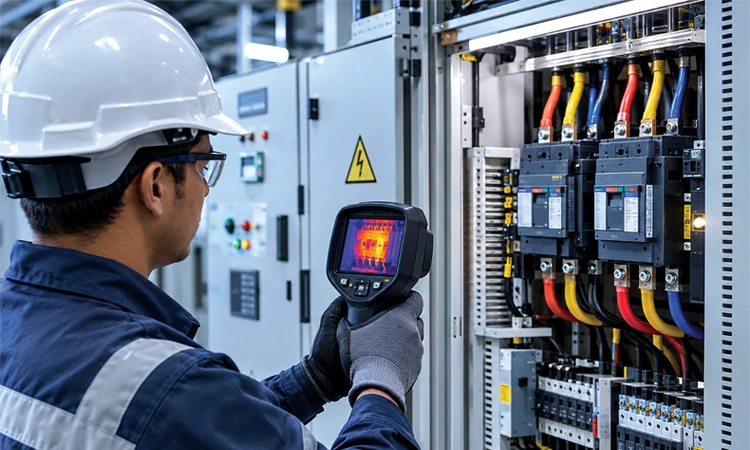
One of the most valuable tools in electrical preventive maintenance is infrared thermography. An infrared camera detects thermal radiation from equipment and converts it into a visual representation of temperature differences.
Electrical resistance increases at points where connections are loose, corroded, contaminated or otherwise defective. Such points can generate excess heat. If left undetected, the condition can progress into insulation damage, arcing, component failure or fire.
Thermal imaging allows maintenance teams to identify these abnormal temperature patterns without physically touching the energised equipment, when performed using appropriate safety procedures and suitably qualified personnel.
Common targets include switchboards, circuit breakers, busbars, cable terminations, contactors, transformers, motor terminals and other electrical connections.
From Hotspot to Root Cause
Thermography does not simply identify a “hotspot”; the real value lies in interpreting what that hotspot means.
A higher temperature at one connection compared with similar phases, for example, may indicate a loose or deteriorated connection. However, temperature differences can also result from unequal loading, component design or environmental factors.
Consequently, thermal images should be interpreted by competent personnel and, where appropriate, correlated with electrical measurements and operating conditions.
The inspection should ideally be performed while equipment is operating under a meaningful load. Equipment inspected under very light load may not reveal a developing thermal problem.
Establishing Baselines
A single thermographic inspection provides useful information, but trend analysis makes thermography considerably more powerful.
By recording thermal images and temperature measurements over successive inspections, maintenance teams can establish a baseline for critical equipment. Changes in temperature or thermal patterns can then be investigated before they develop into failures.
This approach supports condition-based maintenance. Instead of replacing components solely according to a calendar schedule, organisations can prioritise maintenance based on actual equipment condition and risk.
Electrical Safety and Fire Prevention
Electrical faults are a significant contributor to industrial fire risk. Loose connections, overloaded circuits, insulation failures and faulty equipment can generate sufficient heat to ignite combustible materials.
Electrical audits and thermography therefore have an important role in industrial fire prevention. Detecting abnormal heating early can enable maintenance teams to tighten connections, redistribute loads, replace damaged components or correct other underlying problems before an incident occurs.
However, thermography should complement—not replace—other electrical testing and inspection techniques. Insulation resistance testing, earth resistance measurements, power-quality analysis, protection testing and visual inspection may all be necessary depending on the equipment and application.
Safety During Thermographic Inspection
Thermal imaging of live electrical equipment can itself expose personnel to electrical hazards. Appropriate electrical safety procedures, risk assessments, personal protective equipment and safe approach distances are essential.
Where panels need to be opened for thermal inspection, organisations must ensure that the activity is undertaken only by appropriately trained and authorised personnel. The objective of predictive maintenance must never be achieved at the expense of worker safety.
Turning Findings into Action
An audit report is useful only when its recommendations are acted upon. Findings should therefore be categorised according to severity and potential consequences.
Critical observations may require immediate isolation or corrective action. Less urgent observations can be incorporated into planned maintenance programmes. Repeated findings may indicate deeper issues involving design, installation quality, maintenance practices or operational procedures.
Digital maintenance-management systems can help organisations track observations, assign corrective actions and monitor closure. Integrating thermographic records with equipment histories can also create a valuable condition-monitoring database.
Towards Predictive Electrical Safety
The convergence of electrical audits, thermography, power-quality monitoring, sensors and digital maintenance platforms is transforming electrical safety from periodic inspection into continuous risk management.
Advanced facilities can increasingly monitor temperature, load, current, voltage and other parameters remotely. Analytics can identify deviations and alert maintenance teams before abnormal conditions escalate.
Nevertheless, technology remains only one part of the solution. Competent personnel, sound electrical design, preventive maintenance, disciplined operating procedures and a strong safety culture remain fundamental.
For industrial organisations, the combination of electrical safety audits and thermography provides a practical means of identifying hidden hazards, improving equipment reliability and reducing the likelihood of electrical fires and unplanned downtime.
The greatest advantage is not simply finding a hot connection or an overloaded circuit—it is finding it before it becomes a failure. In an increasingly electrified industrial environment, that shift from reacting to failures to predicting and preventing them is central to achieving safer, more reliable and resilient operations.