

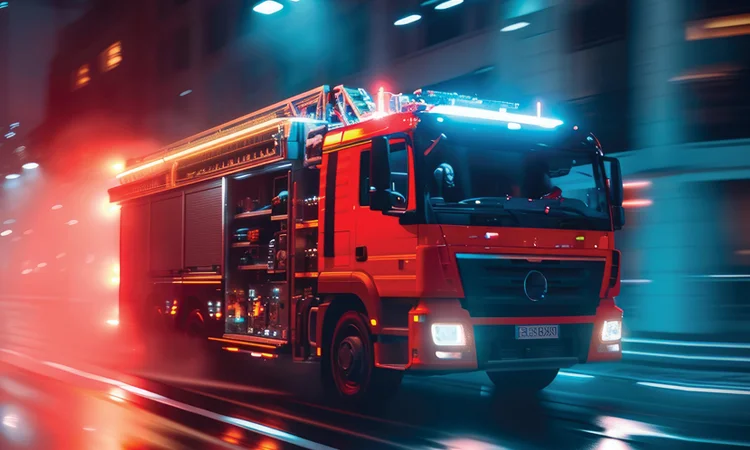
Modern fire vehicles have evolved far beyond conventional fire engines that transport firefighters, water and basic firefighting equipment. Today, they are sophisticated emergency response platforms incorporating high-performance pumping systems, advanced extinguishing technologies, digital communication, thermal imaging and specialised rescue equipment. Designed to respond to diverse emergencies, these vehicles play a vital role in protecting lives, industrial assets, public infrastructure and the environment.
As urbanisation accelerates, industrial facilities become more complex and new hazards emerge from electric vehicles, battery energy storage and hazardous chemicals, fire services increasingly require vehicles tailored to specific operational challenges. The emphasis is on reaching incidents quickly, assessing risks accurately, delivering extinguishing agents efficiently and protecting firefighters throughout the operation.
Evolution of Modern Fire Engines
Traditional fire engines primarily carried water tanks, pumps, hoses, ladders and manual firefighting tools. Modern vehicles integrate these functions into carefully engineered platforms designed for speed, manoeuvrability, reliability and operational flexibility.
Contemporary fire appliances may incorporate high-capacity centrifugal pumps, electronically controlled monitors, onboard foam systems, hydraulic rescue tools and advanced navigation equipment. Depending on their intended application, they can carry thousands of litres of water and specialised firefighting agents.
Vehicle configurations vary considerably. Compact fire tenders serve congested urban neighbourhoods and smaller industrial facilities, while heavy-duty appliances support major industrial emergencies, airports and large commercial complexes. Some vehicles are designed for rapid intervention, whereas others carry extensive equipment for prolonged firefighting and rescue operations.
The selection of an appropriate vehicle depends on the anticipated hazards, road conditions, water availability, access constraints and the response requirements of the facility or fire service.
High-Performance Pumps and Intelligent Water Delivery
The pumping system is one of the most critical components of a modern fire vehicle. Advanced pumps deliver water at the required flow and pressure through hoses, ground monitors, elevated platforms and roof-mounted turrets.
Modern pump panels increasingly incorporate digital displays that show operating pressure, flow rate, tank levels and system status. Automated controls can help maintain consistent discharge conditions and alert operators to abnormal operating parameters.
High-capacity water monitors allow firefighters to deliver powerful streams over substantial distances, making them useful for large industrial fires, fuel storage installations and warehouse emergencies. Remote-controlled monitors can improve positioning accuracy while reducing the need for personnel to operate close to the fire.
Some vehicles also incorporate compressed air foam systems, which mix water, foam concentrate and compressed air to produce firefighting foam. These systems can improve coverage and adhesion in suitable applications, potentially reducing water consumption. Their effectiveness depends on the fuel involved, foam formulation and operating conditions.
Aerial Platforms for High-Rise Firefighting
The proliferation of high-rise buildings has increased demand for aerial ladder trucks and hydraulic platform vehicles. These specialised appliances provide elevated access for rescue operations, firefighting and inspection of difficult-to-reach locations.
Modern aerial platforms incorporate hydraulic controls, stabilising outriggers, load sensors and safety interlocks. Depending on the design, they may reach substantial heights and carry firefighters, rescue equipment or integrated water monitors.
Articulated booms can improve access around certain obstacles, while computer-assisted controls help operators position the platform within approved operating limits.
For densely populated Indian cities, compact aerial appliances may offer advantages where streets are narrow and parking space is limited. However, safe deployment requires adequate ground stability, sufficient clearance, unobstructed access and careful consideration of overhead electrical lines.
Specialised Industrial and Airport Fire Vehicles
Different environments demand different firefighting capabilities.
Industrial fire tenders are equipped for emergencies in refineries, chemical plants, petrochemical complexes and manufacturing facilities. Depending on the hazard, they may carry water, foam concentrate, dry chemical extinguishing agents, specialised monitors and hazardous-material response equipment.
Aircraft rescue and firefighting vehicles are designed for rapid acceleration, high mobility and the delivery of large quantities of extinguishing agents around airport runways and aircraft operating areas. Their specialised turrets and rescue equipment support the demanding requirements of aviation emergencies.
Wildland firefighting vehicles are built for uneven terrain and remote locations. Their design typically prioritises manoeuvrability, ground clearance, compact dimensions and equipment for controlling vegetation fires.
Hazardous-material response vehicles carry gas detectors, chemical protective clothing, containment equipment and specialised tools. These vehicles support incident assessment and mitigation where toxic, corrosive or flammable substances present additional risks.
Electric and Hybrid Fire Vehicles
Electrification is emerging as an important development in emergency vehicle design. Battery-electric and hybrid fire vehicles can reduce local exhaust emissions and operating noise, particularly in urban areas.
Electric propulsion may also supply power to auxiliary equipment, while hybrid configurations combine electric drive capabilities with conventional engines to provide operational flexibility.
However, fire vehicles must perform reliably under demanding conditions, including extended incidents, heavy payloads and continuous operation of auxiliary systems. Battery capacity, charging infrastructure, thermal management, pumping endurance and backup arrangements therefore require careful evaluation.
Electrification is likely to expand as technology matures, but vehicle selection must prioritise dependable emergency performance alongside environmental benefits.
Digitalisation, AI and Thermal Imaging
Digital technologies are transforming emergency vehicle operations. GPS-enabled fleet management allows control rooms to identify available vehicles and support efficient dispatch. Navigation systems can assist drivers in selecting routes, while onboard communication platforms provide incident details and operational updates.
Thermal imaging cameras help firefighters identify hotspots, locate potential victims in smoke-filled environments and assess fire spread. Some advanced systems can integrate thermal imagery with vehicle displays, improving situational awareness for incident commanders.
Artificial intelligence is also being explored for analysing traffic conditions, incident data and resource availability. These tools may support dispatch decisions and operational planning, although human judgement and established emergency procedures remain essential.
Connected vehicle platforms can additionally monitor engine health, pump performance and equipment status. By identifying faults early, these systems can support preventive maintenance and reduce the likelihood of equipment becoming unavailable during an emergency.
Robotics and Remote-Controlled Firefighting
Modern fire services are increasingly exploring robotics to reduce human exposure to dangerous conditions. Remote-controlled ground vehicles can carry thermal cameras, water monitors and other firefighting equipment into locations affected by extreme heat, smoke or hazardous substances.
Such systems are particularly relevant to industrial plants, tunnels, warehouses and chemical facilities where direct access may be dangerous.
Drones equipped with thermal imaging cameras can provide aerial assessments of fire spread, roof conditions and potential hotspots. Specialised firefighting drones are also being developed, although their payload and endurance limitations mean they generally complement rather than replace conventional fire appliances.
Together, these technologies can improve incident assessment and help commanders deploy personnel and equipment more strategically.
Ergonomics, Safety and Sustainable Design
Modern fire vehicle design increasingly prioritises firefighter safety. Improved cabin ergonomics, secure equipment storage, enhanced lighting, reversing cameras and surrounding-area monitoring systems can help reduce operational risks.
Lightweight materials and efficient powertrains can improve vehicle performance and reduce energy consumption. Better equipment organisation also enables crews to retrieve tools quickly without unnecessary movement around the vehicle.
Regular maintenance remains fundamental. Pumps, hoses, monitors, ladders, hydraulic systems, communications equipment and safety devices must be inspected and tested according to applicable requirements. Crew training is equally important to ensure that advanced features translate into effective emergency response.
Conclusion
Today’s modern fire vehicles represent the convergence of automotive engineering, firefighting science, digital technology and specialised rescue capabilities. High-performance pumps, aerial platforms, intelligent monitoring, alternative propulsion and robotic equipment are expanding the range of emergencies that fire services can address.
For India, modernisation must be supported by trained personnel, reliable maintenance, suitable road infrastructure, adequate water supplies and coordinated emergency planning.
Ultimately, the effectiveness of a fire vehicle depends not merely on its speed, size or technological sophistication, but on its ability to deliver the right capability at the right place and time. The modern fire vehicle is more than an emergency transport platform—it is a mobile centre for rapid intervention, intelligent firefighting and life-saving operations.