

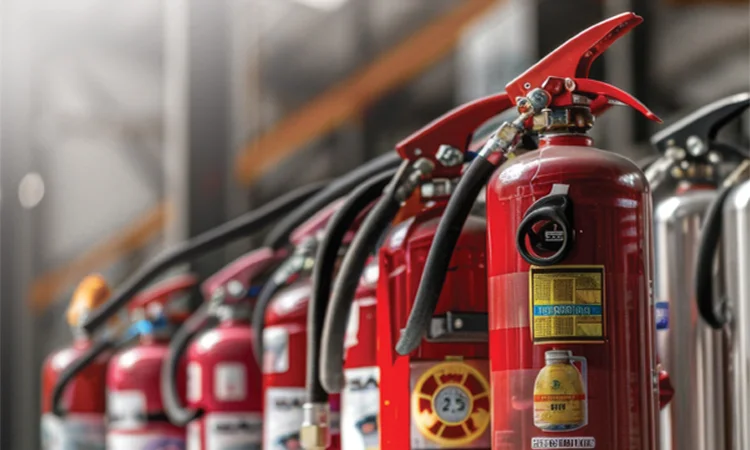
Fire extinguishers have long served as the first line of defence against incipient fires in industrial facilities, commercial establishments, residential buildings and public infrastructure. Traditionally viewed as simple, manually operated safety devices, modern fire extinguishers are evolving into sophisticated fire protection solutions incorporating advanced extinguishing agents, ergonomic designs, intelligent monitoring and environmentally responsible technologies. As fire risks become more complex, innovations in extinguisher technology are enhancing response effectiveness, user safety and operational reliability.
Evolving Extinguishing Agents
One of the most significant areas of innovation is the development of advanced extinguishing agents. Conventional extinguishers rely on water, foam, dry chemical powders or carbon dioxide, each suited to specific fire hazards. However, emerging applications involving lithium-ion batteries, sensitive electronics, high-value machinery and specialised industrial processes demand more targeted solutions.
Water-mist extinguishers represent an important advancement. By releasing extremely fine water droplets, these systems absorb heat efficiently and help suppress flames while using considerably less water than conventional water-based equipment. Their reduced water consumption can also minimise secondary damage, although suitability depends on the specific extinguisher’s certification and the hazards present.
Innovations in foam technology are also reshaping fire protection. Manufacturers are developing fluorine-free firefighting foams as alternatives to formulations containing per- and polyfluoroalkyl substances (PFAS), which raise environmental and health concerns. These newer formulations aim to deliver effective fire suppression while reducing persistent chemical contamination. Their performance must nevertheless be validated for the particular fuel, application and operating conditions.
Clean-agent extinguishers are increasingly valuable in server rooms, control centres, laboratories and other environments where residue from conventional agents could damage equipment. Carbon dioxide extinguishers also remain useful for certain flammable-liquid and electrical fire scenarios, provided appropriate precautions are taken against asphyxiation and other hazards.
Addressing Lithium-Ion Battery Fires
The proliferation of electric vehicles, energy storage systems, portable electronics and battery-powered industrial equipment has introduced new fire protection challenges. Lithium-ion battery incidents can involve thermal runaway, rapid heat release, toxic gases and the possibility of reignition.
Specialised extinguishing products are being developed for battery-related incidents, including water-based cooling solutions, targeted application equipment and agents designed to improve heat transfer or suppress flames. However, no single portable extinguisher can guarantee the prevention of thermal runaway or reignition in every battery fire.
For larger battery systems, effective protection may require integrated detection, automatic suppression, thermal management, isolation systems and carefully planned emergency response procedures. Extinguishers should therefore be selected according to battery chemistry, equipment design, fire-test evidence and manufacturer guidance.
This shift highlights a broader principle: the future of fire extinguishers lies not merely in putting out flames, but in addressing the specific hazards associated with modern materials and technologies.
Smart Extinguishers and IoT Integration
Digitalisation is bringing intelligence to traditionally passive fire safety equipment. Smart extinguishers can incorporate sensors, electronic monitoring devices and wireless connectivity to improve maintenance and readiness.
Depending on the design, these devices can monitor pressure, installation status, temperature, tampering and maintenance schedules. Connected monitoring platforms can notify facility managers when an extinguisher is removed, improperly positioned or due for inspection. Integration with building management systems and digital safety dashboards can further improve visibility across large industrial campuses, warehouses, hospitals and commercial complexes.
Radio-frequency identification (RFID), QR codes and digital asset registers are also simplifying extinguisher management. Maintenance personnel can access inspection records, service histories and equipment specifications through digital interfaces. This reduces dependence on paper-based records and helps organisations identify overdue inspections or missing equipment.
Predictive maintenance is another emerging opportunity. By analysing historical service information and sensor readings, digital platforms may help prioritise maintenance interventions. Such technologies complement rather than replace mandatory physical inspections and statutory maintenance requirements.
Ergonomic Designs and Improved Usability
During a fire emergency, seconds matter. Extinguishers must be easy to locate, understand and operate, even by individuals with limited training. Manufacturers are responding with improved handles, clearer operating instructions, lighter materials and more intuitive activation mechanisms.
Compact extinguishers are particularly useful in vehicles, small workshops, kitchens and confined spaces. Improved cylinder construction and corrosion-resistant materials can enhance durability while helping reduce weight. Wall-mounted units, vehicle brackets and specialised carrying arrangements are also being redesigned to improve accessibility and secure placement.
Visual instructions, colour-coded identification and pictograms can help users recognise extinguisher types quickly. Some advanced products incorporate electronic indicators or audible guidance to support correct operation. However, simplified controls cannot eliminate the need for training, particularly when dealing with rapidly developing fires or hazardous industrial environments.
Aerosol and Condensed-Aerosol Technologies
Condensed-aerosol fire suppression is gaining attention in selected fixed-protection applications. These systems generate fine particles that interfere with the combustion process and can suppress fires using relatively compact equipment. Their space-saving characteristics make them attractive for certain electrical cabinets, machinery enclosures and specialised equipment compartments.
Unlike conventional portable extinguishers, many aerosol systems are designed for automatic or fixed installation rather than routine manual firefighting. Their suitability depends on enclosure conditions, occupancy, ventilation, fire class and manufacturer certification. Appropriate safeguards are essential wherever discharged agents may affect people, visibility or equipment.
Advances in compact suppression technologies are expanding the options available to designers, but they must be selected through a proper hazard assessment rather than treated as universal replacements for conventional extinguishers.
Sustainability and Environmental Responsibility
Environmental performance is becoming an important consideration in fire protection. The transition towards fluorine-free foams, more sustainable materials, longer-lasting components and improved serviceability reflects the industry’s growing focus on lifecycle impact.
Manufacturers are also exploring recyclable packaging, reduced material consumption and cylinder designs that support refurbishment where permitted. Longer service life, reliable refillability and responsible disposal can reduce waste and improve the economics of fire safety programmes.
At the same time, sustainability must not compromise firefighting performance. Every agent and extinguisher design must satisfy applicable performance, safety and certification requirements. Environmental claims should be supported by credible testing and evidence.
Choosing the Right Extinguisher
Technological innovation delivers value only when the correct equipment is selected, installed and maintained. Water-based extinguishers may suit certain ordinary combustible-material fires, while dry chemical, foam, carbon dioxide and specialised agents serve different applications. Energised electrical equipment, flammable metals and lithium-ion batteries require particular care because an unsuitable agent can increase danger.
Organisations should assess fire classes, fuel characteristics, electrical hazards, occupancy, environmental conditions and potential collateral damage before finalising their extinguisher selection. In India, applicable requirements under relevant fire safety regulations, the National Building Code, and pertinent BIS standards should be considered alongside local fire authority requirements.
Regular inspections, authorised servicing, staff training and unobstructed access remain indispensable, regardless of technological sophistication.
The Road Ahead
Innovations in fire extinguishers are transforming first-response protection through smarter monitoring, specialised agents, improved ergonomics and greater environmental responsibility. As industrial processes evolve and new hazards emerge, extinguishers will increasingly form part of integrated fire safety strategies involving intelligent detection, automatic suppression and digital maintenance systems.
The ultimate objective remains unchanged: to control an incipient fire quickly, protect people and minimise damage. By combining technological progress with sound risk assessment, regulatory compliance and effective training, organisations can make fire extinguishers more reliable, sustainable and capable of meeting the challenges of modern fire protection.
P.K. Balasubramanian
editor@divyamediaonline.com