

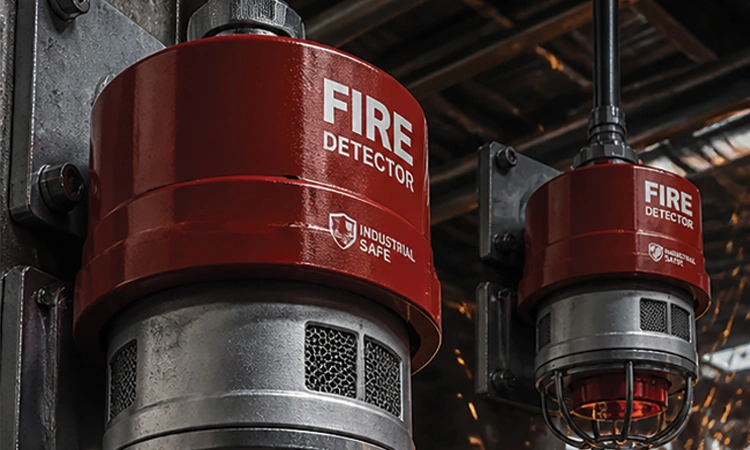
Fire detection is the cornerstone of any effective fire protection strategy. While standard smoke and heat detectors perform well in clean, climate-controlled environments such as offices and commercial buildings, they often struggle in industrial settings where dust, humidity, vibration, corrosive gases, extreme temperatures and airborne contaminants are commonplace. In these harsh environments, conventional detectors can generate frequent false alarms, experience reduced sensitivity or even fail to detect a fire in time.
To address these challenges, manufacturers have developed specialized fire detectors engineered to deliver reliable performance under demanding operating conditions. These advanced detection technologies combine rugged construction, intelligent sensing and sophisticated signal processing to ensure dependable fire protection in some of the world’s toughest industrial environments.
The Challenges of Harsh Industrial Environments
Factories, process plants and infrastructure facilities expose fire detection systems to conditions rarely encountered in commercial buildings. Dust from machining, mining, cement production and grain handling can accumulate inside detector chambers, impairing their performance. High humidity and water spray in food processing plants, paper mills and wastewater treatment facilities may lead to false alarms or corrosion of sensitive components.
Similarly, chemical plants and offshore installations expose detectors to corrosive gases, salt-laden air and aggressive vapours, while steel plants, foundries and glass manufacturing units operate in extremely high ambient temperatures. Warehouses with refrigerated storage present the opposite challenge, where sub-zero temperatures can affect conventional equipment.
Frequent vibration from heavy machinery, cranes and compressors, along with electromagnetic interference generated by large motors and high-voltage equipment, further complicates reliable fire detection.
These conditions demand detection systems specifically designed to withstand environmental stresses without compromising sensitivity or response time.
Types of Fire Detectors for Challenging Areas
Industrial Smoke Detectors
Industrial-grade smoke detectors feature sealed optical chambers, insect screens and contamination-resistant designs that prevent dust and airborne particles from affecting detector performance. Many models incorporate automatic drift compensation, continuously adjusting sensitivity as contamination levels change while alerting maintenance personnel when cleaning is required.
These detectors are widely used in manufacturing plants, warehouses and logistics centres where moderate levels of dust are unavoidable.
Heat Detectors
In locations where smoke detection is impractical due to airborne particles, heat detectors offer a dependable alternative. They activate when the ambient temperature reaches a predetermined threshold or rises rapidly within a short period.
Heat detectors are particularly suited for:
- Machine shops
- Boiler rooms
- Commercial kitchens
- Parking garages
- Industrial workshops
- Dusty production areas
Because they are unaffected by dust or steam, heat detectors significantly reduce nuisance alarms.
Flame Detectors
Flame detectors are indispensable in facilities handling flammable liquids and gases. These devices identify the ultraviolet (UV), infrared (IR) or combined UV/IR radiation emitted by flames, enabling extremely rapid fire detection.
Modern multi-spectrum flame detectors employ sophisticated algorithms to distinguish actual fires from welding arcs, sunlight reflections and hot machinery, minimizing false activations.
Typical applications include:
- Oil and gas facilities
- Petrochemical plants
- Aircraft hangars
- Fuel storage terminals
- Power generation stations
- Hydrogen processing facilities
Aspirating Smoke Detection Systems
For environments where conventional smoke detectors may be difficult to access or maintain, aspirating smoke detection (ASD) systems offer a highly sensitive solution. These systems continuously draw air samples through a network of pipes into a central detection unit that analyses even microscopic smoke particles.
Because the detection chamber is located away from harsh environmental conditions, ASD systems maintain exceptional reliability even in dusty or inaccessible locations.
Common installations include:
- Data centres
- Clean rooms
- Cold storage warehouses
- Cable tunnels
- High-bay warehouses
- Industrial process areas
Linear Heat Detection
Linear Heat Detection (LHD) systems consist of heat-sensitive cables installed along conveyors, cable trays, tunnels, storage racks and industrial equipment. Instead of monitoring a single point, these systems provide continuous temperature sensing over long distances.
LHD systems are particularly valuable in applications where installing numerous point detectors would be impractical.
Industries benefiting from linear heat detection include:
- Mining
- Power transmission
- Conveyor systems
- Warehousing
- Railway infrastructure
- Waste recycling plants
Intelligent Multi-Criteria Detectors
Modern industrial facilities increasingly deploy multi-criteria detectors that combine multiple sensing technologies within a single device. By simultaneously analysing smoke, heat, flame characteristics and environmental conditions, these detectors can distinguish between actual fire events and harmless environmental disturbances.
Artificial intelligence and advanced digital signal processing further enhance reliability by continuously learning environmental conditions and adapting detector response accordingly.
The result is faster fire detection with substantially fewer false alarms.
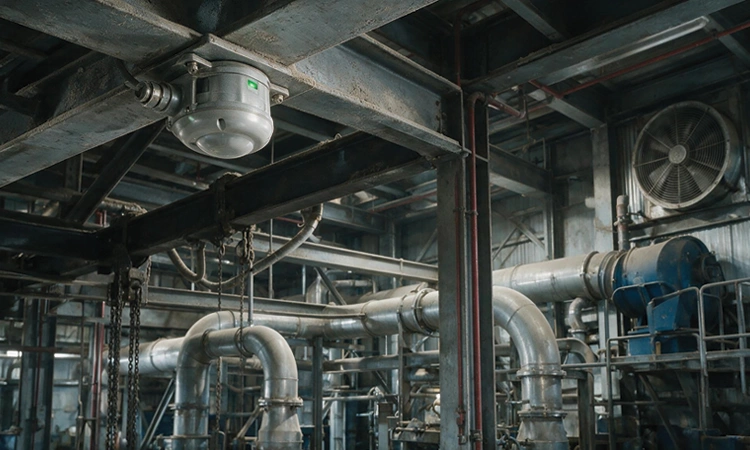
Explosion-Proof Fire Detectors
Facilities handling explosive atmospheres require detectors certified for hazardous areas. These explosion-proof devices are designed to operate safely in environments containing combustible gases, vapours or dust without becoming an ignition source.
Such detectors comply with stringent hazardous-area standards and are widely installed in:
- Chemical processing plants
- Oil refineries
- Pharmaceutical manufacturing
- Paint shops
- Grain silos
- LNG terminals
Their rugged enclosures protect sensitive electronics while ensuring reliable operation under demanding conditions.
Smart Connectivity and Remote Monitoring
Digital technologies have significantly enhanced the effectiveness of fire detection systems in harsh environments. Addressable detectors equipped with network connectivity enable continuous monitoring of detector health, environmental conditions and system performance.
Maintenance teams receive real-time notifications regarding contamination levels, sensitivity changes and device faults, allowing preventive maintenance before performance deteriorates.
Integration with Industrial Internet of Things (IIoT) platforms enables centralized monitoring across multiple facilities, while cloud-based analytics provide valuable insights into detector trends and maintenance requirements.
Reducing False Alarms
False alarms are among the greatest challenges in industrial fire protection. Frequent nuisance alarms interrupt production, reduce confidence in safety systems and may lead personnel to ignore genuine emergencies.
Manufacturers address this issue through innovations such as:
- Advanced digital filtering algorithms
- Multi-sensor verification
- Adaptive sensitivity adjustment
- Automatic contamination compensation
- Environmental compensation software
- Intelligent event discrimination
These technologies enable detectors to distinguish between actual fire signatures and normal industrial phenomena such as dust clouds, welding operations, steam or exhaust emissions.
Installation and Maintenance Considerations
Selecting the right detector is only part of an effective fire detection strategy. Proper installation, commissioning and periodic maintenance are equally critical.
Key considerations include:
- Environmental conditions
- Ceiling height
- Airflow patterns
- Dust concentration
- Humidity levels
- Chemical exposure
- Accessibility for maintenance
- Compliance with fire safety standards
Routine inspection, testing and calibration ensure detectors continue to perform reliably throughout their service life. Many modern systems also feature self-diagnostic capabilities that simplify maintenance planning and improve system availability.
Future Trends in Industrial Fire Detection
The future of fire detection for environmentally challenging areas lies in intelligent, connected and predictive technologies. Artificial intelligence, machine learning and thermal imaging are enabling earlier identification of abnormal conditions before ignition occurs. Advanced video analytics, autonomous inspection robots and drones equipped with infrared cameras are increasingly being used to monitor large industrial facilities, tunnels and remote installations.
Digital twins and predictive maintenance platforms are expected to further improve fire safety by continuously assessing equipment condition, environmental factors and operational risks. As industries adopt smart manufacturing and Industry 4.0 practices, fire detection systems will become even more integrated with building management systems, process controls and emergency response networks.
Conclusion
Environmentally challenging areas demand fire detection solutions that go far beyond conventional smoke alarms. Dust, heat, moisture, vibration, corrosive atmospheres and explosive environments require detectors specifically engineered for durability, accuracy and reliability. From aspirating smoke detection and multi-spectrum flame detectors to linear heat sensing and AI-enabled multi-criteria devices, today’s technologies provide dependable protection even under the harshest operating conditions.
As industrial facilities become more automated and complex, investing in application-specific fire detection systems is essential for safeguarding personnel, protecting critical assets and ensuring uninterrupted operations. Reliable detection is not merely the first step in fire protection-it is the foundation upon which an effective and resilient fire safety strategy is built.