

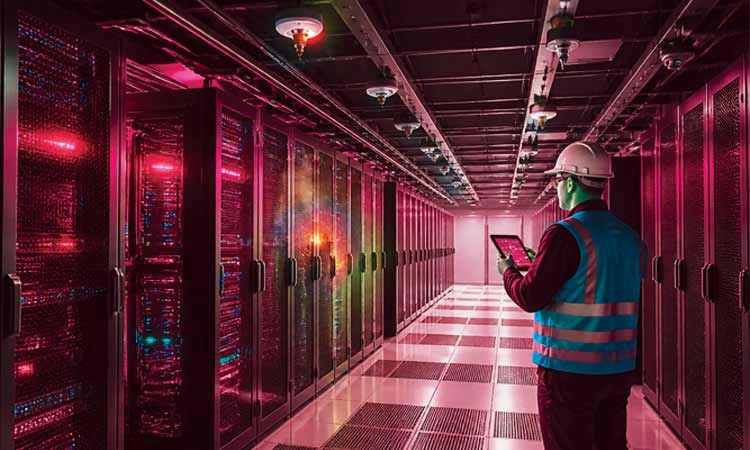
As the digital economy expands, data centres and mission-critical facilities have become the backbone of modern business and public infrastructure. Financial transactions, cloud services, telecommunications, healthcare, manufacturing, government services and artificial intelligence increasingly depend on uninterrupted digital operations. In such environments, a fire is more than a safety incident—it can become a major business-continuity and national-infrastructure challenge. Fire safety in a data centre therefore demands a fundamentally different approach. The objective is not simply to extinguish a fire, but to detect the earliest signs of thermal activity, prevent escalation, protect critical equipment and maintain operational continuity, while ensuring the safety of personnel.
Why Data Centres Are Different
Data centres present a unique combination of fire risks. Large concentrations of electrical and electronic equipment, extensive cable networks, batteries, UPS systems, generators, transformers and cooling infrastructure create multiple potential ignition sources.
At the same time, modern facilities are designed around high availability. Conventional firefighting methods that introduce large quantities of water can potentially cause extensive damage to sensitive electronic equipment—even when the original fire is relatively small.
This makes early detection and targeted suppression particularly important. Fire protection must be designed as an integrated system that addresses the entire facility, including server rooms, electrical rooms, battery rooms, cable spaces, generator areas, storage zones and ancillary spaces.
Detecting Fire Before It Becomes Fire
In a mission-critical facility, conventional smoke detection may not always provide sufficient warning. By the time visible smoke reaches a conventional detector, a developing problem could already threaten critical equipment.
Very early smoke detection systems (VESDA-type aspirating systems) continuously draw air samples through a network of pipes and analyse them for extremely small concentrations of smoke particles. This can provide an early warning of overheating or incipient fire, allowing operators to investigate and intervene before conditions deteriorate.
Detection should ideally be supported by multiple layers, including smoke, heat and other appropriate sensing technologies. Intelligent monitoring can also integrate fire alarms with building-management and security systems, enabling operators to obtain a comprehensive picture of an incident.
Suppression Without Collateral Damage
The choice of fire-suppression technology is critical. For areas containing sensitive electronic equipment, clean-agent systems are commonly considered because they can suppress fire without leaving damaging residues or requiring extensive post-fire clean-up.
Depending on the application and design requirements, systems may employ gaseous agents or other specialised suppression technologies. The objective is rapid extinguishment while protecting equipment and allowing the facility to recover quickly.
Water-based systems, however, continue to have an important role in appropriate areas of data-centre facilities, particularly for building protection and spaces where water discharge does not pose an unacceptable equipment risk. Pre-action sprinkler systems can provide an additional layer of protection while reducing the likelihood of accidental water discharge into equipment spaces.
The correct strategy is therefore not water versus gas, but a carefully engineered combination of protection systems suited to each risk zone.
Battery and Energy-Storage Risks
The rapid adoption of lithium-ion batteries for UPS and energy-storage applications has introduced another dimension to data-centre fire safety. Battery thermal runaway can generate intense heat and potentially release flammable gases, making detection, isolation, ventilation and suppression particularly important.
Battery rooms and energy-storage installations require dedicated risk assessments addressing battery chemistry, configuration, charging systems, thermal management, spacing and emergency response. Protection should also consider the possibility of re-ignition, since extinguishing visible flames does not necessarily eliminate the underlying thermal hazard.
As energy-storage technologies evolve, data-centre fire strategies must evolve with them.
Passive Protection and Compartmentation
Active systems represent only one part of the solution. Passive fire protection helps prevent fire and smoke from travelling between critical areas.
Fire-rated walls, floors, ceilings, doors and firestopping systems can compartmentalise a facility and provide valuable time for detection, response and evacuation. Particular attention must be given to cable penetrations, pipe openings, ventilation systems and other service routes.
In a data centre, thousands of cables may pass between rooms and floors. Poorly protected penetrations can compromise otherwise robust fire-rated barriers. Firestopping must therefore be treated as a complete tested system rather than simply filling gaps with a fire-resistant material.
Cooling Systems: An Often-Overlooked Risk
Cooling is fundamental to data-centre operation, but HVAC systems can also influence fire behaviour. Air movement can transport smoke and heat rapidly through a facility.
Fire and smoke control strategies should therefore be integrated with the HVAC design. Appropriate dampers, controls, zoning and shutdown sequences can help limit smoke movement while maintaining essential environmental conditions where required.
The challenge is to balance fire containment with operational resilience. A poorly designed shutdown strategy could itself affect equipment and service availability.
Emergency Power and Fire Safety
Mission-critical facilities depend heavily on uninterrupted power. UPS systems, batteries, diesel generators and associated electrical infrastructure introduce additional fire hazards.
Electrical protection should therefore incorporate appropriate equipment selection, preventive maintenance, thermal monitoring, cable management and overload protection. Infrared thermography and other condition-monitoring techniques can help identify abnormal heating before it develops into an incident.
Fire protection should also be coordinated with emergency power systems so that essential detection, alarm, suppression and life-safety functions remain available during power interruptions.
From Compliance to Resilience
Standards and regulations provide an essential foundation, but mission-critical facilities require a broader risk-management philosophy. Fire protection design should consider not only the probability of fire, but also the consequences of downtime.
A robust fire-safety strategy brings together early detection, automatic suppression, passive fire protection, smoke management, emergency power, compartmentation, trained personnel and clearly defined response procedures. Regular testing, inspection and maintenance are equally important.
Fire drills and emergency exercises should go beyond evacuation. Data-centre operators should also test incident escalation procedures, equipment isolation, communication protocols, remote monitoring, business-continuity arrangements and recovery plans.
Protecting the Digital Backbone
The increasing dependence of industry and society on digital infrastructure makes fire safety in data centres a strategic necessity. A successful protection system must achieve two objectives simultaneously: protect people from fire and protect critical operations from interruption.
The future will demand increasingly intelligent fire-protection solutions—combining advanced sensors, analytics, remote monitoring, thermal imaging and automated response with proven passive and active protection technologies.
Ultimately, fire safety in a data centre cannot be an afterthought. It must be embedded into the facility’s design, construction, operation and maintenance philosophy. For mission-critical edifices, the true measure of fire protection is not merely whether a fire can be extinguished, but whether the facility can contain the incident, protect its people and critical assets, and continue—or rapidly resume—its mission.