
The Experiment Has Left The Fume Hood When Laboratory Risk Becomes a Building Problem

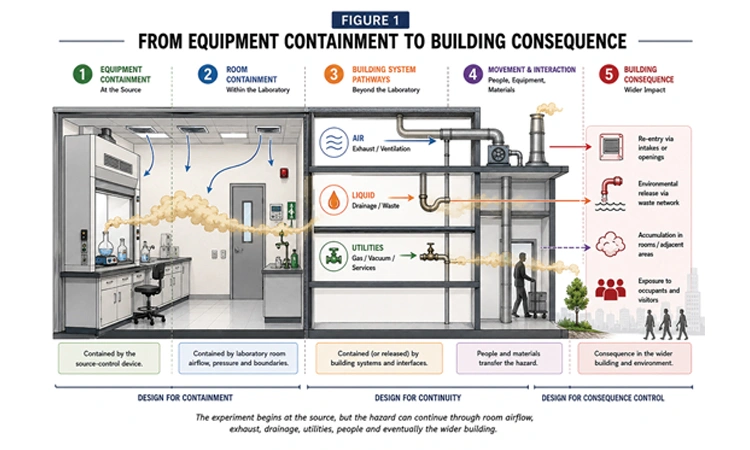
Laboratory safety is often discussed through equipment. The fume hood, gas cabinet, local exhaust system, detector, emergency shower and waste system each receive their own design criteria, testing requirements and operating procedures. This equipment-focused approach is necessary, but it can create a dangerous assumption that the hazard ends where the safety device ends.
In reality, laboratory hazards continue to move through the building. A vapour released during an experiment can become a room-airflow problem, then an exhaust problem, and later a re-entrainment problem at an outdoor-air intake. A chemical spill can move into drainage and become a materials, treatment or environmental problem. A gas leak can involve ventilation, controls, electrical isolation and emergency power simultaneously.
The important issue is not simply that laboratories are complex. It is that laboratory hazards do not recognise the boundaries through which buildings are designed. HVAC, plumbing, electrical, controls, architecture and laboratory equipment may each be reviewed independently, while the hazard experiences them as one continuous physical environment.
This is where laboratory safety becomes a building problem.
The fume hood is used here as the starting point because it makes this boundary problem visible; the principle is broader and applies wherever a laboratory hazard can migrate from its source into room, utility or building systems.
Fume-Hood Performance Is Not Laboratory Containment
The chemical fume hood is one of the most important source-control devices in a laboratory. Its purpose is to capture contaminants generated within the enclosure and prevent unacceptable exposure to the operator. ASHRAE Standard 110 provides a recognised method for testing hood performance, while SEFA guidance reinforces that containment should not be judged from face velocity alone.
The distinction is important because face velocity describes the average air speed through the sash opening, while containment depends on the three-dimensional airflow field at and around that opening, including turbulence, reverse-flow zones, wake effects and the interaction between supply-air momentum and hood exhaust.
A hood can perform correctly under a defined test condition while the room around it introduces disturbances that weaken actual containment. Supply-air diffusers, cross-drafts, moving people, door operation, thermal plumes and equipment placement can influence airflow at the hood face. None of these represents a failure of the hood itself. They are failures at the interface between the hood and its environment.
This is one of the central weaknesses in conventional laboratory review. A hood may be correctly selected while the HVAC design also satisfies room airflow requirements, yet a diffuser positioned too close to the working face may disrupt capture. Each system can appear correct when reviewed independently, while their interaction creates the risk.
The same principle appears elsewhere. Room pressure interacts with doors. Exhaust stacks interact with fresh-air intakes. Chemical drains interact with downstream waste systems. Gas detection interacts with emergency sequences. Laboratory safety therefore depends not only on whether each system performs, but on what one system can do to another.
Negative Pressure Is Not a Wall
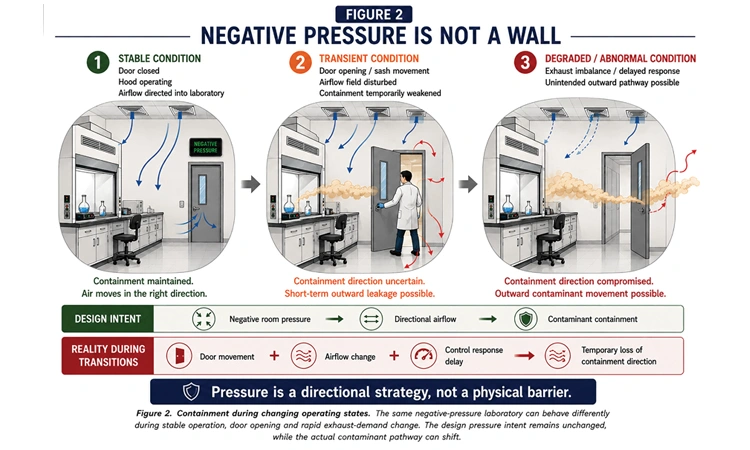
Negative pressure is widely used in laboratories to encourage airflow from cleaner adjoining spaces toward areas containing hazards. It is an important containment strategy, but it should not be interpreted as a physical barrier.
The pressure relationship exists because supply, exhaust and transfer air are held in a controlled balance. That balance changes whenever the operating state changes. Doors open. Fume-hood sashes move. VAV valves respond. Exhaust devices stage on or off. Fans lose capacity.
Consider a laboratory with several VAV fume hoods. If two users raise their sashes at nearly the same time, exhaust demand can increase quickly. The supply system then has to respond while maintaining the intended room relationship and avoiding excessive air movement around the hood faces.
For dynamic laboratories, the engineering issue is therefore not only the steady-state pressure differential but also the response time and stability of the airflow-control system relative to the speed of sash movement, door operation and exhaust-demand change.
The control loop may eventually stabilise, but the more important engineering question is what happens during the transition. Contaminant movement can occur in seconds. If a door opens during the same period, the intended directional relationship may weaken further. The room-pressure monitor may soon return to its specified value, while the contaminant has already followed a temporary path toward the adjoining space.
This is why steady-state pressure verification alone is not enough for critical laboratories. Commissioning should examine realistic transitions such as sash movement, door opening, exhaust-fan changeover and loss of a major airflow device. The objective is not simply to prove that a pressure number can be maintained, but to understand whether credible operating changes can create an unintended contaminant pathway.
Room pressure should therefore be understood as a directional strategy, not a safety certificate.
The Hood Captured It. The Building Can Still Bring It Back.
A laboratory exhaust system presents one of the clearest examples of risk crossing engineering boundaries. A volatile chemical may be successfully captured by the hood, transported through the duct and discharged through the exhaust stack. From the perspective of the room, containment has worked.
The engineering question must therefore continue beyond the fan: where does the plume travel after discharge?
Stack position, discharge velocity, nearby structures, roof geometry and wind influence plume behaviour. If dispersion is poor, contaminants intentionally removed from the laboratory can migrate toward an outdoor-air intake, operable window or occupied location.
The source-control system may therefore perform exactly as intended while the building recreates the exposure elsewhere.
This is why removal and disposal should be treated as different engineering functions. Removing contaminated air from the laboratory is only the first part. The second is ensuring that the material does not re-enter the same building or affect another occupied area.
The risk becomes more significant on dense research campuses where exhaust stacks, AHU intakes, future buildings and rooftop plant compete for space. A discharge location that appears acceptable when reviewed on a mechanical drawing may become problematic once the surrounding architecture and wind environment are considered.
For complex facilities, exhaust-discharge design should be evaluated in the context of recognised laboratory ventilation and building air-intake/exhaust guidance, including ANSI/ASSP Z9.5 and the ASHRAE Handbook, particularly the chapters on Laboratories and Building Air Intake and Exhaust Design. Where building geometry, nearby structures or intake locations make plume behaviour uncertain, dispersion modelling or wind-tunnel assessment may be justified. The purpose is not to add analysis for its own sake, but to answer a practical question: can anything intentionally exhausted from this laboratory be unintentionally brought back into the building?
Some Experiments Leave Through the Floor
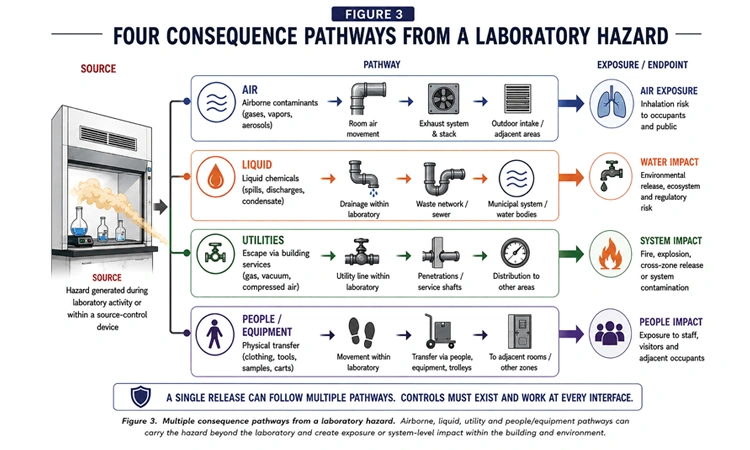
Airborne hazards receive most of the attention in laboratory containment, but liquid pathways can be equally important. A corrosive, reactive or solvent-bearing liquid may be spilled near a bench and initially contained. During cleanup or emergency response, however, part of that material may reach a sink, floor drain or process-waste connection.
At that moment, the hazard has moved into another engineering system, where the critical questions concern pipe compatibility, waste segregation, possible mixing, vapour generation, treatment and final disposal. The laboratory may look clean after the spill while the consequence has simply moved somewhere less visible.
Segregation may therefore need to begin before the waste reaches the drainage network. Depending on the laboratory process, aqueous acidic or alkaline streams may require controlled neutralisation, while solvent-bearing or incompatible chemical wastes may require dedicated collection rather than connection to the common drainage system. The correct arrangement must follow the actual waste chemistry and the facility’s approved treatment and disposal strategy.
A laboratory drain should therefore not be treated as ordinary plumbing. It can become a chemical transport system. The risk may increase downstream if incompatible substances combine, if piping materials are unsuitable or if the receiving system was never intended to handle that waste stream.
The correct strategy depends on the laboratory type and the materials involved. Chemical, biomedical and pharmaceutical facilities cannot all be treated through one generic drainage detail. In the Indian context, the waste pathway must also reflect the nature of the laboratory activity and the applicable regulatory framework, including the Hazardous and Other Wastes (Management and Transboundary Movement) Rules, 2016, as amended, and, where biomedical waste is involved, the Bio-Medical Waste Management Rules, 2016, as amended.
A useful engineering principle is simple: no laboratory waste connection should become anonymous after it leaves the room. The team should know what can enter it, what it can mix with and where it finally terminates.
When a Gas Leak Becomes a Building Event
Hazardous gas systems show how quickly a local fault can become a whole-building problem. Consider a compressed-gas system where storage, piping and detection have all been properly designed. If a fitting fails inside the laboratory, the initial mechanical defect is only the beginning.
Release rate influences concentration. Room volume and ventilation influence dilution. Gas characteristics influence where accumulation occurs. Detector type and location influence recognition time. Controls determine whether the source is isolated. Exhaust influences how quickly the atmosphere recovers. Doors and pressure relationships influence migration.
Electrical systems also become part of the consequence if isolation valves, detectors, exhaust fans or controls rely on emergency power. A gas release during loss of normal supply can therefore create a very different condition from the one assumed during routine operation.
This is why detection should never be treated as the end of the safety strategy. A detector provides information. It does not, by itself, create a safe state. The real safety function lies in the cause-and-effect sequence that follows detection: source isolation, ventilation response, equipment shutdown, alarm escalation, emergency power continuity and occupant action must be coordinated so that one protective response does not unintentionally defeat another.
The engineering sequence must define what happens next. Depending on the hazard, this may involve source isolation, continuation of exhaust, shutdown of selected equipment, alarm annunciation or evacuation. There is no universal response sequence suitable for every laboratory, but there should always be a defined response.
A useful design-review question is therefore not merely whether the detector is connected to the BMS. It is whether detector operation actually interrupts the consequence pathway.
People Are Also Part of the Pathway
Not every laboratory hazard moves through ducts or pipes. A technician may work correctly inside a fume hood yet transfer contamination through gloves, equipment, door handles or waste containers.
In such a case, the hood can perform correctly, the room can remain negative and the ventilation system can satisfy every design criterion. Contamination can still leave the laboratory because the transport mechanism is a person rather than an air stream.
This does not make the issue purely procedural. Laboratory planning affects how easily contamination can move. Hand-wash locations, PPE transition points, waste routes, pass-through arrangements, equipment movement and door positions can either support containment or undermine it.
The designer cannot control every action, but the design can make safe movement easier and unsafe movement less convenient. This becomes particularly important in laboratories where chemical, biological or potent-compound risks coexist with frequent personnel and sample movement.
The question therefore should not be limited to what air crosses the laboratory boundary. It should also consider what people, equipment, samples and waste cross it.
The Most Important Condition May Be the One We Never Commission
Laboratory systems are usually commissioned under controlled operating conditions, with supply air available, exhaust fans running, controls communicating, doors closed and electrical power stable. An actual incident, however, may occur under a very different system state: a spill may coincide with loss of normal power, an exhaust fan may trip while vapour generation continues, a standby fan may start after a delay, or dampers and control valves may move to their defined fail positions while occupants open doors in response to the event.
Each component may have a defined failure response, but the combined laboratory response may never have been tested.
A redundant exhaust fan, for example, provides limited safety value if the control system does not start it correctly, the electrical source is unavailable or damper movement temporarily reverses the room pressure relationship.
The important commissioning question is therefore not only whether each component assumes its specified failure state, but whether those individual responses collectively move the laboratory toward a safer condition. A component can behave exactly as designed in isolation while contributing to an unsafe system condition when its response interacts with ventilation, controls, power or occupant movement.
Follow the Consequence Across Disciplines
Traditional laboratory design reviews are organised by discipline because that is how buildings are designed. Mechanical engineers review ventilation. Electrical engineers review power. Plumbing engineers review drainage. Architects review layout. Controls specialists implement sequences.
The weakness arises when the safety review ends at the same boundaries.
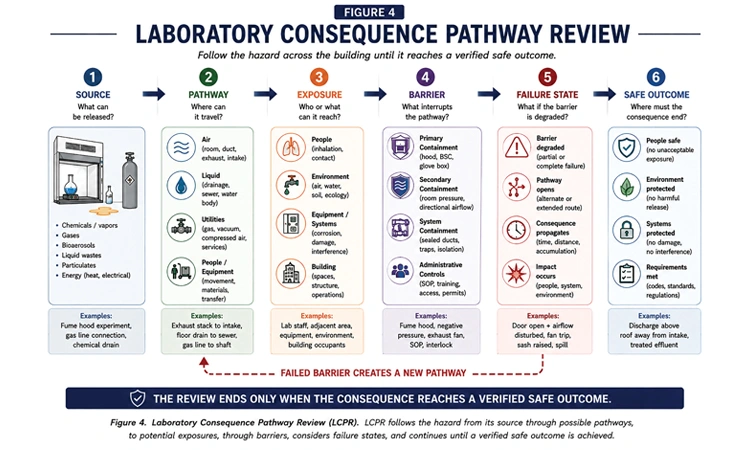
Laboratory hazards need one additional review in which the team stops following drawings and starts following consequences. I call this the Laboratory Consequence Pathway Review, or LCPR.
LCPR does not replace HAZOP, chemical-risk assessment, industrial-hygiene review, code compliance, ASHRAE 110 testing or commissioning. Nor does it introduce another risk-analysis method. Its purpose is different: to interrogate a multidisciplinary building design by following the consequence rather than the engineering discipline. The pathway can be expressed as:
Source → Pathway → Exposure → Barrier → Failure State → Safe Outcome
For example, consider a solvent release inside a fume hood. The hood is the first barrier, but if capture is disturbed, the room becomes the next pathway and the operator or adjoining space becomes the next exposure point. If room containment is also degraded, the consequence can move into the exhaust or corridor system. The review continues until the release reaches a verified safe endpoint such as controlled exhaust discharge without re-entrainment or exposure.
The source is the actual hazard generated by the process: vapour, gas, liquid, aerosol, heat, pressure or contaminated material. The pathway is whatever allows it to move: air, duct, doorway, drain, pipe, shaft, person or equipment. Exposure identifies what can be affected next, whether that is a researcher, adjoining space, AHU intake, waste system, maintenance worker or emergency responder.
The barrier is the measure expected to interrupt the path. It may be the hood, directional airflow, gas cabinet, secondary containment, waste segregation, detector, interlock or exhaust discharge arrangement.
The critical stage of the review is to examine what happens when the barrier is degraded, unavailable or overwhelmed. A hood sash may remain too high, a door may be held open, a fan may trip, a sensor may drift, a diffuser may be relocated during fit-out, or a new process may exceed the assumptions made during the original design. In each case, the failed or weakened barrier does not necessarily terminate the consequence; it can create another pathway through which the hazard continues to propagate.
The review should therefore continue until the hazard reaches a defined safe outcome such as controlled discharge, isolation at source, contained recovery, appropriate waste treatment or verified safe shutdown. If the team cannot clearly identify that endpoint, the consequence review is not complete.
A Different Design Conversation
Once consequences are reviewed instead of only components, familiar design questions become more useful. The HVAC discussion moves beyond ACH to actual airflow around source-control devices. Room-pressure review includes doors, sash positions and fan transitions. Exhaust review extends beyond fan duty to plume behaviour and re-entrainment.
Drainage review moves beyond pipe material to waste compatibility and final destination. Controls review asks what actually happens after an alarm. Electrical review identifies which safety systems must remain energised and which processes should intentionally shut down.
This does not require one discipline to design another consultant’s system. It requires each discipline to understand how its own system influences the movement, containment or eventual safe termination of the hazard. That is the practical value of the pathway approach.
Conclusion
The strongest laboratory is not necessarily the one with the highest air-change rate, largest exhaust fan, most sophisticated BMS or even the best-performing fume hood. Those systems matter, but they are only parts of the containment strategy.
What matters more is whether the design team understands where the hazard can travel after it leaves its original source. A vapour captured by the hood still has to be discharged safely. Negative pressure must continue to support directional containment during changing operating states. A spill entering a drain transfers the consequence into another system. A detector is useful only if its operation produces an effective response.
Laboratory safety therefore requires two levels of engineering thought. The first asks whether each system can perform its intended function. The second asks what happens when that system is disturbed, degraded or bypassed, and where the consequence goes next. The first establishes component performance and compliance; the second determines whether those components, when interacting under real operating and failure conditions, collectively create a safe laboratory.
That question should be asked before drawings are frozen, before exhaust stacks and drainage routes are finalised, and before control sequences are approved. Once the experiment begins, the hazard will not follow discipline boundaries or design packages; it will follow the physical pathway the building actually provides. The final test of laboratory safety is therefore not whether each barrier exists, but whether the complete consequence pathway has been understood, challenged and verified under both normal and credible abnormal states. When that pathway extends beyond the source-control device, the experiment has left the fume hood and laboratory risk has become a building problem.

About the Author
Madhava Narasimha Murthy Nedunuri is a senior MEP leader with two decades of experience delivering complex high-rise, township, mall, hospital, hotel, and data-center projects across India. He began his career with engineering roles in IL&FS, Shapoorji Pallonji, HCC, and Bhartiya Urban (formerly Urbanac), progressing into strategic project leadership positions where he shaped design standards, execution quality, and safety culture. His work blends deep technical understanding with a systems-thinking approach to MEP integration, hydraulic performance, fire engineering, and sustainability. Known for his clarity in engineering logic and his commitment to mentoring teams, he continues to contribute to industry conversations through technical writing, thought leadership, and applied field insights.