
Water Mist Systems and Their Usage
A Modern, Efficient and Environmentally Responsible Approach to Fire Suppression

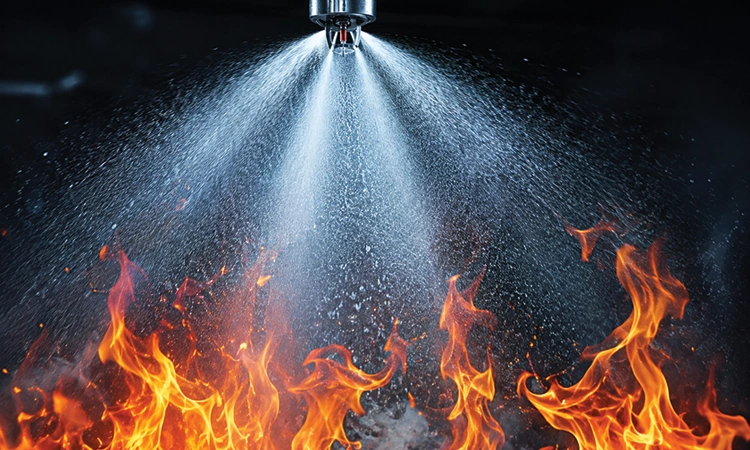
Fire suppression technology has evolved considerably over the past few decades, driven by the need for greater efficiency, enhanced safety and reduced environmental impact. While conventional sprinkler systems continue to play a vital role in protecting buildings and industrial facilities, water mist systems have emerged as an advanced fire suppression solution capable of controlling or extinguishing fires with significantly less water. Their ability to rapidly cool flames, reduce oxygen concentration around the fire and minimize water damage has made them increasingly popular across a wide range of applications. Today, water mist technology is protecting everything from data centres and hospitals to marine vessels, power plants, heritage structures and industrial facilities, offering a highly effective alternative where conventional sprinklers may not be the ideal choice.
What is a Water Mist System?
A water mist system is an active fire protection system that discharges extremely fine water droplets through specially designed nozzles at high or intermediate pressure. Unlike traditional sprinklers that release relatively large droplets, water mist systems atomize water into microscopic particles, dramatically increasing the total surface area of the water.
This larger surface area enables the droplets to absorb heat more rapidly, convert quickly into steam and suppress fire more efficiently while using a fraction of the water required by conventional systems.
Depending on the application, water mist systems may operate at low, intermediate or high pressure, with nozzle designs optimized for specific fire hazards and enclosure characteristics.
How Water Mist Suppresses Fire
Water mist systems extinguish fires through a combination of physical mechanisms rather than relying solely on cooling.
Rapid Cooling
The microscopic droplets absorb heat extremely efficiently, reducing the temperature of the flames and surrounding gases. This cooling effect slows combustion and prevents the fire from spreading to adjacent materials.
Oxygen Displacement
As the fine droplets evaporate, they produce steam that expands rapidly. The resulting steam displaces oxygen in the immediate vicinity of the fire, reducing the oxygen available to sustain combustion without creating hazardous conditions for occupants.
Radiant Heat Reduction
Water mist forms a barrier between the flames and nearby combustible materials, significantly reducing radiant heat transfer. This helps prevent fire propagation and protects equipment, structures and escape routes.
Surface Wetting
Some droplets settle on nearby surfaces, cooling combustible materials and preventing re-ignition after the fire has been controlled.
The combination of these mechanisms makes water mist systems highly effective against many classes of fire.
Components of a Water Mist System
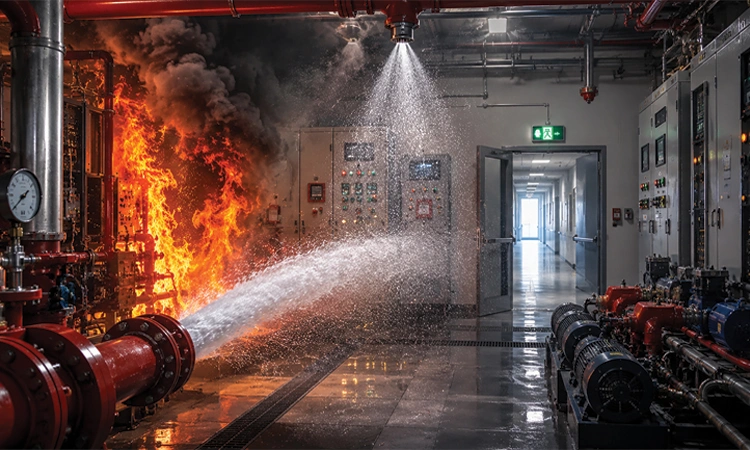
A typical water mist installation comprises several key components that work together to deliver rapid and reliable fire suppression:
- Water storage tank or dedicated water supply
- High-pressure or intermediate-pressure pump unit
- Stainless steel piping network
- Precision-engineered mist nozzles
- Detection and control system
- Directional valves and pressure regulators
- Automatic activation devices or manual release stations
Modern systems are often integrated with intelligent fire detection and building management systems for coordinated emergency response.
Types of Water Mist Systems
Water mist systems are generally classified according to operating pressure.
Low-Pressure Systems
Operating below approximately 12.5 bar, these systems are suitable for selected commercial and residential applications where moderate fire suppression capability is required.
Intermediate-Pressure Systems
These systems typically operate between 12.5 and 35 bar and provide enhanced atomization, making them suitable for industrial facilities, machinery spaces and specialized hazards.
High-Pressure Systems
Operating above 35 bar-and in many cases exceeding 100 bar-high-pressure water mist systems generate extremely fine droplets with exceptional cooling capability. They are widely used in critical industrial installations, marine applications, turbine enclosures and high-value asset protection.
The selection of operating pressure depends on the occupancy, fire risk, enclosure geometry and applicable fire protection standards.
Advantages of Water Mist Technology
One of the greatest strengths of water mist systems is their ability to achieve effective fire suppression using substantially less water than traditional sprinklers.
Key advantages include:
Reduced Water Consumption
Water mist systems may use up to 80–90% less water than conventional sprinkler systems, conserving water resources while reducing drainage requirements.
Minimal Water Damage
Since only a small volume of water is discharged, sensitive equipment, electrical installations, archives, artworks and machinery suffer significantly less collateral damage after fire suppression.
Faster Fire Control
The rapid cooling action enables quicker suppression of flames, reducing the likelihood of fire spread and structural damage.
Enhanced Occupant Safety
Unlike some gaseous suppression systems that require sealed enclosures or evacuation before discharge, water mist systems are generally safe for occupied spaces when properly designed.
Environmentally Friendly
Water is a natural extinguishing medium that leaves no chemical residue, has no ozone depletion potential and produces no greenhouse gas emissions associated with certain synthetic suppression agents.
Lower Cleanup Costs
Following discharge, cleanup is generally faster and less expensive than after foam or powder-based suppression systems.
Applications Across Industries
Water mist technology has found widespread acceptance in diverse sectors due to its versatility.
Industrial Manufacturing
Machine tools, CNC machining centres, printing presses, power generation equipment and industrial machinery can benefit from localized water mist protection, especially where lubricants or hydraulic fluids present fire risks.
Data Centres
Electronic equipment is highly susceptible to water damage. Water mist systems provide effective fire suppression while minimizing disruption to servers, networking equipment and electrical infrastructure.
Marine and Offshore Installations
Ships, offshore platforms and engine rooms have adopted water mist technology extensively because of limited onboard water availability and stringent fire safety requirements.
Healthcare Facilities
Hospitals, laboratories and pharmaceutical plants require uninterrupted operation and protection of sensitive equipment. Water mist systems offer reliable suppression with minimal impact on critical services.
Heritage Buildings and Museums
Historic structures, libraries, archives and museums often contain irreplaceable collections that could be severely damaged by conventional sprinklers. Water mist provides effective protection while significantly reducing water-related damage.
Commercial Buildings
Hotels, airports, shopping malls and office complexes increasingly incorporate water mist systems in selected high-risk areas where rapid suppression and minimal disruption are priorities.
Design Considerations
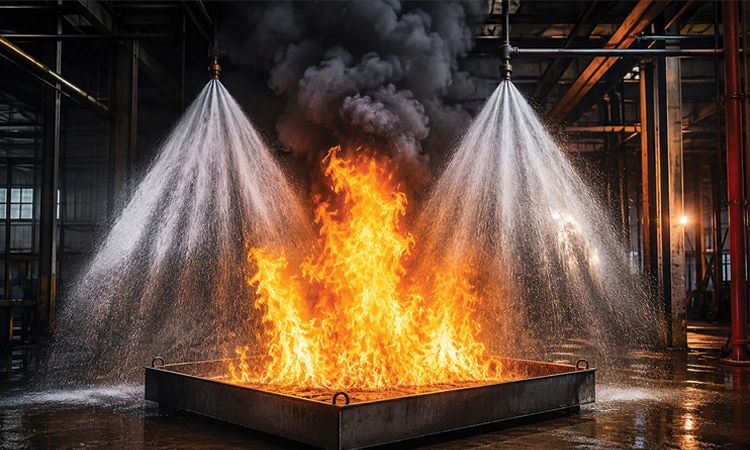
Effective performance depends on careful engineering and application-specific design.
Important factors include:
- Fire hazard classification
- Ceiling height
- Ventilation and airflow
- Room geometry
- Nozzle spacing
- Operating pressure
- Water supply capacity
- Detection and activation methods
Water mist systems should always be designed, installed and commissioned by qualified professionals in accordance with recognized fire protection standards.
Maintenance Requirements
Like all active fire protection systems, water mist installations require periodic inspection and maintenance to ensure reliable operation.
Routine activities include:
- Pump performance testing
- Nozzle inspection and cleaning
- Pipework examination
- Valve operation checks
- Water quality verification
- Detection system testing
- Pressure monitoring
- Control panel diagnostics
Many modern systems incorporate self-monitoring features that continuously assess system health and alert maintenance personnel to potential issues before they affect performance.
Emerging Innovations
Advancements in digital technology are further enhancing the capabilities of water mist systems. Smart controllers, Internet of Things (IoT) connectivity and cloud-based monitoring now enable remote supervision, predictive maintenance and real-time diagnostics. Integration with building management systems allows coordinated operation of alarms, smoke control systems, ventilation shutdown and emergency evacuation procedures.
Researchers are also developing more efficient nozzle designs, variable-pressure pumps and hybrid suppression systems that combine water mist with inert gases or foam for specialized applications. Such innovations are expanding the scope of water mist technology into battery energy storage systems (BESS), electric vehicle manufacturing, renewable energy installations and high-hazard industrial processes.
Future Outlook
As industries place increasing emphasis on sustainability, operational resilience and protection of high-value assets, water mist technology is expected to see wider adoption. The demand for fire suppression systems that use less water, minimize environmental impact and reduce downtime aligns perfectly with the strengths of water mist systems.
Growing investments in smart buildings, digital infrastructure, advanced manufacturing and critical facilities will further drive innovation in this field. Future systems are likely to become even more intelligent, energy-efficient and application-specific, delivering enhanced fire protection while supporting environmental and business continuity goals.
Conclusion
Water mist systems represent one of the most significant advancements in modern fire suppression technology. By employing ultra-fine water droplets, they rapidly cool fires, reduce oxygen around the flames and limit radiant heat, all while using a fraction of the water consumed by conventional sprinklers. Their ability to protect sensitive equipment, minimize water damage and support sustainable fire protection makes them an increasingly preferred solution across industrial, commercial and institutional sectors.
As fire risks evolve and facilities become more technologically sophisticated, water mist systems are poised to play an even greater role in safeguarding lives, preserving valuable assets and ensuring uninterrupted operations. Their blend of efficiency, versatility and environmental responsibility makes them a key component of the next generation of active fire protection systems.